
1. COURSE DESCRIPTION
Financial Management is designed to equip students with the skills that would be expected from a financial
manager responsible for the finance function of a business. The course begins with the introduction of the
role and purpose of the financial management function within a business. In addition the course covers the
three key financial management decisions of investing, financing, and dividend policy.
The following section discusses the two stages of investment; investment in working capital and long-
term investments. The next area covers the financing decisions: the examination of the various sources of
business finance, including the dividend policy and internally generated finance. Cost of capital and other
factors influence the choice of capital by the business. In addition, the course covers the valuation of the
business and financial assets, and their impact on the cost of capital. At the end of the course, we examine
the risk and the main techniques used to manage it.
2. REASON FOR THE COURSE
Financial Management examines the theory and practice of corporate investment and financial decisions.
Its aim is to provide an understanding of some of the central decision problems in corporate finance
relating to the daily management of the working capital, the long-term capital investment needed to
replace productive assets, the financing of both short-term and long-term assets, and the dividend policy
decisions. Students will be introduced to financial concepts and theories applied to finance-related issues
encountered by firms in real-life situations focusing upon the role of the Financial Manager and the theory
and skills required to make sound investment and financing decisions. The course deals with the theory and
techniques of financial decision-making in a corporate context. Students will gain an understanding of why
maximising shareholders wealth is regarded as a primary financial objective of a firm. In addition, students
will develop their comprehension of the following key financial decisions – investment, financing, dividends
and risk management – as paramount to creating wealth.
3. STUDY HOURS

4. ROLE IN CURRICULUM
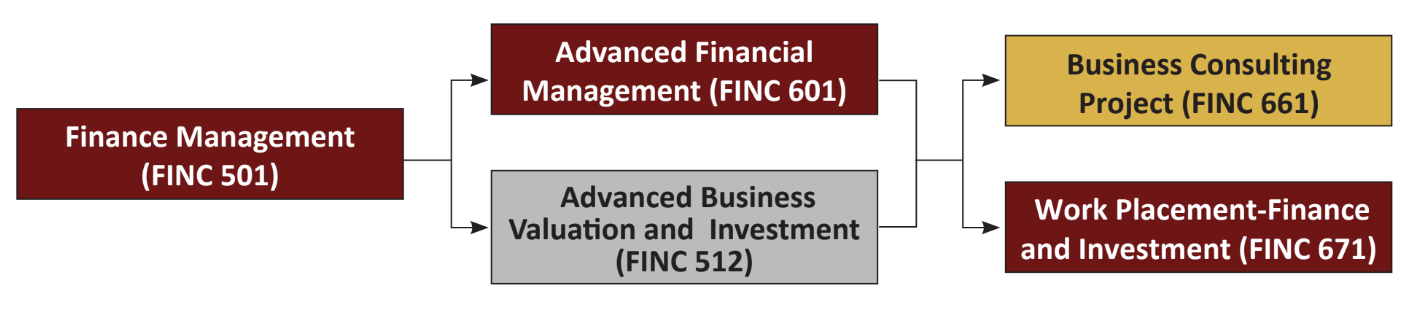
Prerequisites:
There are no prerequisites other than the program entrance requirements.
The learning outcomes for this course cover four main areas in corporate finance: investment decisions, financing decisions, dividend policy decisions and working capital management. On successful completion of this course, students will be able to:
| Knowledge | Level of Learning | Related PLO |
|---|---|---|
| Explain theory, concepts, and practice of corporate finance (CK1) Explain the theory, concepts and practice of corporate financial management function and discuss the impact of economic environment on financial management. |
Understand | PC1 |
| Discuss working capital management techniques (CK2) Discuss working capital management techniques in a business organisation. |
Understand | PC3 |
| Discuss the different techniques of decision-making (CK3) Discuss the different techniques of financial decision-making in the areas of investment, financing, dividends and risk management that an organisation may apply to maximise shareholders wealth. |
Understand | PC1 |
| Cognitive Skills | Level of Learning | Related PLO |
| Make a Strategic Financial Decision-Making (CC1) Carry out effective investment appraisal and financing analysis to guide business in making informed decisions to maximise the wealth of the shareholders |
Evaluate | PC1 |
| Assessing Finance Options and Costs (CC2) Evaluate alternative sources of business finance and their respective cost to plan business growth and maximise the wealth of shareholders. |
Evaluate | PC3 |
| Apply Holistic Business Management: Valuation and Risk Strategies (CC3) Apply principles of business valuation and risk management techniques in business |
Evaluate | PC1 |
| Communication, Information Technology, and Numerical Skills | Level of Learning | Related PLO |
| Leveraging Spreadsheet Proficiency for Financial Analysis (CCIT1) Use spreadsheets to analyze and demonstrate problem solving and critical skills in analysing financial information such as capital budgeting. |
Apply | PCIT1 |
| Interpersonal Skills and Responsibilities | Level of Learning | Related PLO |
| Develop Team-Based Approaches in Action (CIP1) Work in a team to perform financial planning and control. |
Respond | PIP1 |
Grades will be determined based on a grading score, calculated using the following assessments and score allocations:
| SKILL | CLO Assessment and Scoring | Skill Weighting for Grade |
||
|---|---|---|---|---|
| Participation | Take-home case studies (3) |
Final Exam |
||
| Explain theory, concepts, and practice of corporate finance (CK1) | 100% | 10% | ||
| Discuss working capital management techniques (CK2) | 100% | 10% | ||
| Discuss the different techniques of decision-making (CK3) | 100% | 10% | ||
| Make a Strategic Financial Decision-Making (CC1) | 50% | 50% | 10% | |
| Assess Finance Options and Costs (CC2) | 50% | 50% | 20% | |
| Apply Holistic Business Management: Valuation and Risk Strategies (CC3) | 50% | 50% | 10% | |
| Leverage the Spreadsheet Proficiency for Financial Analysis (CCIT1) | 30% | 70% | 20% | |
| Develop Team-Based Approaches in Action (CIP1) | 40% | 60% | 10% | |
This course is primarily lecture based, case study analysis and problem application based on past
examinations published by ACCA for Financial Management paper (F9) and Harvard Business School case
studies. Assigned readings will support learning and serve as a reference to material covered in class. During
class, approximately half of the class will be devoted to lecture with another half of the class working on
case studies and problem sets and reviewing the solutions.
The course targets the study plan below. Implementation may vary somewhat depending on the progress and needs of students. For example, some topics may be allocated more or less than 1.5 hours.
| Lesson Learning Outcomes | Teaching and Learning Activities, Assessment |
|
|---|---|---|
| 1 | The financial management and objectives
|
Reading: |
| 2 | The financial management and objectives
|
Reading: |
| 3 | The financial management and objectives
|
Reading: |
| 4 | The economic environment
|
Reading: |
| 5 | The economic environment
|
Reading: BPP Text Chapter 2 pp 25-44 |
| 6 | The economic environment
|
Reading: BPP Text Chapter 2 pp 25-44 |
| 7 | Investment decisions using non-discounted cash flow methods
|
Reading: BPP Text Chapter 5 pp 106-134 |
| 8 | Investment appraisal using discounted cash flow methods
|
Reading: BPP Text Chapter 5 pp 106-134 |
| 9 | Investment appraisal using discounted cash flow methods (continued)
|
Reading: BPP Text Chapter 5 pp 106-134 |
| 10 | Capital budgeting under inflation and taxation
|
Reading: BPP Text Chapter 6 pp 135-156 |
| 11 | Capital budgeting under inflation and taxation (continued)
|
Reading: BPP Text Chapter 6 pp 135-156 |
| 12 | Capital budgeting under inflation and taxation (continued)
|
Reading: BPP Text Chapter 6 pp 135-156 |
| 13 | Project appraisal under risk
|
Reading: BPP Text Chapter 7 pp 157-200 |
| 14 | Project appraisal under risk (continued)
|
Reading: BPP Text Chapter 7 pp 157-200 |
| 15 | Specific investment decisions (continued)
|
Reading: BPP Text Chapter 8 pp 173-200 |
| 16 | Sources of finance
|
Reading: BPP Text Chapter 9 & 10 pp 201-232 |
| 17 | Sources of finance (continued)
|
Reading: BPP Text Chapter 9 & 10 pp 201-232 |
| 18 | Dividend policy
|
Reading: BPP Text Chapter 9 & 10 pp 201-232 |
| 19 | Dividend policy (continued)
|
Reading: BPP Text Chapter 9 & 10 pp 201-232 |
| 20 | Cost of capital
|
Reading: BPP Text Chapter 11 pp 233-261 |
| 21 | Cost of capital (continued)
|
Reading: BPP Text Chapter 11 pp 233-261 |
| 22 | Cost of capital (continued)
|
Reading: BPP Text Chapter 11 pp 233-261 |
| 23 | Gearing and capital structure
|
Reading: BPP Text Chapter 12 pp 263-292 |
| 24 | Gearing and capital structure (continued)
|
Reading: |
| 25 | Gearing and capital structure (continued)
|
Reading: |
| 26 | Introduction to working capital management
|
Reading: |
| 27 | Introduction to working capital management
|
Reading: |
| 28 | Managing working capital
|
Reading: |
| 29 | Managing working capital (continued)
|
Reading: |
| 30 | Managing working capital (continued)
|
Reading: |
| 31 | Financing working capital
|
Reading: |
| 32 | Financing working capital (continued)
|
Reading: |
| 33 | Financing working capital (continued)
|
Reading: |
| 34 | Business valuation
|
Reading: |
| 35 | Business valuation (continued)
|
Reading: |
| 36 | Business valuation (continued)
|
Reading: |
| 37 | Business valuation (continued)
|
Reading: |
| 38 | Business valuation (continued)
|
Reading: |
| 39 | Foreign currency
|
Reading: |
| 40 | Foreign currency risk (continued)
|
Reading: |
| 41 | Foreign currency risk (continued)
|
Reading: |
| 42 | Foreign currency risk (continued)
|
Reading: |
| 43 | Foreign currency risk (continued)
|
Reading: |
| 44 | Foreign currency risk (continued)
|
Reading: |
| 45 | Team Presentations – Complete Report (CK1, CC1, CCIT1, CIP1) |
Team presentations and feedback |
| 46 | Team Presentations – Complete Report (CK1, CC1, CCIT1, CIP1) |
Team presentations and feedback |
| 47 | Team Presentations – Complete Report (CK1, CC1, CCIT1, CIP1) |
Team presentations and feedback |
| 48 | Team Presentations – Complete Report (CK1, CC1, CCIT1, CIP1) |
Team presentations and feedback |
| 49 | Team Presentations – Complete Report (CK1, CC1, CCIT1, CIP1) |
Team presentations and feedback |
| 50 | Exam Review | |
Textbook
1. BPP Learning Media, Paper F9 Financial Management, Up to June 2021.
2. BPP Learning Media, Practice & Revision Kit Paper F9 Financial Management, Up to June 2021.
References
1. Kaplan Publishing, Paper F9 Financial Management, Up to December 2021.
2. Watson, D. and Head, A. (2019) Corporate Finance Principles and Practice, Pearson. 8th Edition,
Pearson.
3. Arnold, G. (2009) The Financial Times Guide to Investing, Pearson.
4. Brealey, R. and Myers, S. (2010) Principles of Corporate Finance—Global Edition, McGraw-Hill.
5. Das, S. (2012) Extreme Money: The Masters of the Universe and the Cult of Risk, Pearson.
6. Perks, R. and Leiwy, D. (2010) Accounting: Understanding & Practice, McGraw-Hill.
7. Nofsinger, K., Kim, J.R. and Mohr, D.J. (2010) Corporate Governance, International Edition, Pearson.
8. ACCA Technical Articles: To be assigned in class under selected topics.