
1. COURSE DESCRIPTION
Advanced Financial Management is designed to equip students with the skills that would be expected
from a financial controller responsible for the finance function of a business. The course begins with
the introduction of the role and purpose of the financial management function within a multinational
organisation context. In addition the course covers the four strategic financial management decision areas
of advanced investment appraisal,acquisitions and mergers,corporate reconstruction and reorganisation
and treasury and advanced risk management.
The following section discusses the evaluation of potential investment decisions and assessing their financial
and strategic consequences,both domestically and internationally. The next area covers the assessment
and planning of acquisitions and mergers as an alternative growth strategy together with corporate
reorganisation strategies.Relevant cost of capitals for every decision will be derived after considering the
risks involved and free cash flow valuations will be highlighted in all these decisions.Free cash flow to equity
holders will be used to illustrate dividend policy and maximum dividend capacity of company. In addition,
the course covers the evaluation of alternative treasury and risk management techniques.
2. REASON FOR THE COURSE
Advanced Financial Management examines the theory and practice of corporate investment and financial
decisions. Its aim is to provide an understanding of some of the strategic issues which are critical to the
organisation such as using the right techniques to make investment decisions,acquisition and restructuring
of business to enhance shareholder wealth together with minimising risk for the shareholder. Focus will
also be on the financing aspects for company commitments and dividend policy decisions. Students will
be introduced to financial concepts and theories applied to finance-related issues encountered by firms
in real-life situations focusing upon the role of the Financial Controller and the theory and skills required
to make sound investment and financing decisions. The course deals with the theory and techniques of
financial decision-making in a corporate context. Students will gain an understanding of why maximising
shareholders wealth is regarded as a primary financial objective of a firm. In addition, students will develop
their comprehension of the following key financial decisions – investment, financing, dividends and risk
management – as paramount to creating wealth.
3. STUDY HOURS

4. ROLE IN CURRICULUM
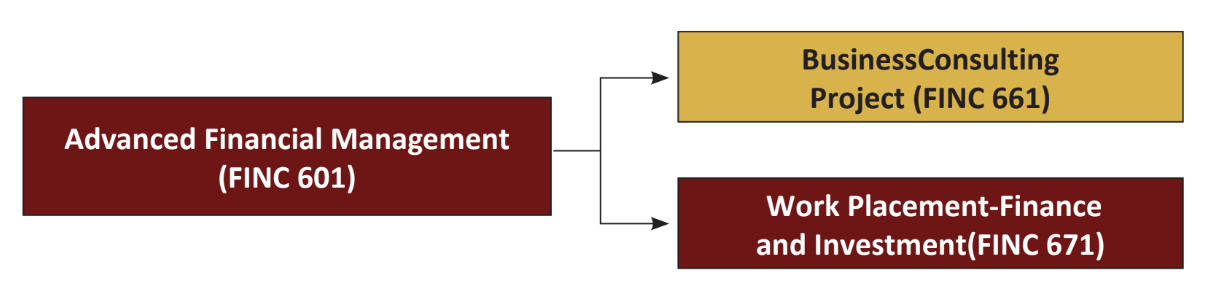
Prerequisites:
Students must have completed Financial Management FINC 501 before attempting this course.
The learning outcomes for this course cover four main areas in corporate finance: Investment decision, Financing decision, Dividend policy decision and Working capital management. On successful completion of this course, students will be able to:
| Knowledge | Level of Learning | Related PLO |
|---|---|---|
| Corporate Financial Management (CK1) Explain the theory, concepts and practice of corporate financial management function and discuss the impact of economic environment on financial management |
Understand | PK1 |
| Exploring Effective Working Capital Management (CK2) Discuss working capital management techniques in a business organisation |
Understand | PK2 |
| Draw Strategic Financial Decision-Making (CK3) Discuss the different techniques of financial decision-making in the areas of investment, financing, dividends and risk management that an organisation may apply to maximise shareholders wealth. |
Understand | PK3 |
| Cognitive Skills | Level of Learning | Related PLO |
| Investment Appraisal and Financing Analysis (CC1) Carry out effective investment appraisal and financing analysis to guide business in making informed decision to maximise the wealth of the shareholders |
Evaluate | PC1 |
| Optimizing Growth (CC2) Evaluate alternative sources of business finance and their respective cost to plan business growth and maximise the wealth of shareholders. |
Evaluate | PC2 |
| Applying Valuation Principles and Risk Management (CC3) Apply principles of business valuation and risk management techniques in business |
Apply | PC3 |
| Communication, Information Technology, and Numerical Skills | Level of Learning | Related PLO |
| Excel Proficiency in Financial Analysis (CCIT1) Use Microsoft Excel software to analyze and demonstrate problem solving and critical skills in analysing financial information such as capital budgeting. |
Apply | PCIT1 |
| Interpersonal Skills and Responsibilities | Level of Learning | Related PLO |
| Team-Based Financial Planning and Control (CIP1) Work in a team to perform financial planning and control. |
Respond | PIP1 |
Grades will be determined based on a grading score, calculated using the following assessments and score allocations:
| Skill | Assessment | Skill Weighting for Grade |
||
|---|---|---|---|---|
| Participation | Take-home case studies (3) |
Final Exam |
||
| Corporate Financial Management (CK1) | 100% | 10% | ||
| Exploring Effective Working Capital Management (CK2) | 100% | 10% | ||
| Strategic Financial Decision-Making (CK3) | 100% | 10% | ||
| Investment Appraisal and Financing Analysis (CC1) | 50% | 50% | 10% | |
| Optimizing Growth (CC2) | 50% | 50% | 20% | |
| Applying Valuation Principles and Risk Management (CC3) | 50% | 50% | 10% | |
| Excel Proficiency in Financial Analysis (CCIT1) | 30% | 70% | 20% | |
| Team-Based Financial Planning and Control (CIP1) | 40% | 60% | 10% | |
This course is primarily lecture based, case study analysis and problem application based on past
examinations published by ACCA for Advanced Financial Management paper (P4) and Harvard Business
School case studies. Assigned readings will support learning and serve as a reference to material covered in
class. During class, approximately half of the class will be devoted to lecture with another half of the class
working on case studies and problem sets and reviewing the solutions.
The course targets the study plan below. Implementation may vary somewhat depending on the progress and needs of students. For example, some topics may be allocated more or less than 1.5 hours.
| Lesson Learning Outcomes | Teaching and Learning Activities, Assessment |
|
|---|---|---|
| 1 |
Advanced Financial Management & Objectives
|
Reading: |
| 2 |
The role and responsibility of senior financial adviser in multinational organisation (MNC)
|
Reading: |
| 3 |
Financial Strategy formulation
|
Reading: |
| 4 |
Financial Strategy Formulation
|
Reading: |
| 5 |
Ethical and governance issues
|
Reading: |
| 6 |
Ethics and governance issues
|
Reading: |
| 7 |
Investment decisions using non-discounted cash flow methods
|
Reading: |
| 8 |
Investment appraisal using discounted cash flow methods
|
Reading: |
| 9 |
Investment appraisal using discounted cash flow methods (continued)
|
Reading: |
| 10 |
Capital budgeting under capital constraints.
|
Reading: |
| 11 |
Capital budgeting under capital constraints (continued)
|
Reading: |
| 12 |
New developments in Investment appraisal techniques
|
Reading: |
| 13 |
Project appraisal under risk
|
Reading: |
| 14 |
Project appraisal under risk (continued)
|
Reading: |
| 15 | Review of investment appraisal with capital rationing and new developments included. |
Reading: |
| 16 |
Sources of finance
|
Reading: |
| 17 |
Sources of finance (continued)
|
Reading: |
| 18 |
Sources of finance (continued)
|
Reading: |
| 19 |
Sources of finance (continued) & WACC(cost of capital)
|
Reading: |
| 20 |
Cost of capital
|
Reading: |
| 21 |
Cost of capital (continued)
|
Reading: |
| 22 |
Adjusted Present Value (APV) method of investment appraisal
|
Reading: |
| 23 |
APV (continued)
|
Reading: |
| 24 |
Mergers And Acquisition (M&A)
|
Reading: |
| 25 |
M & A (continued)
|
Reading: |
| 26 |
M & A (continued)
|
Reading: |
| 27 |
M&A – Restructuring strategies (continued)
|
Reading: |
| 28 |
M&A – Restructuring strategies (continued)
|
Reading: |
| 29 | M&A – Restructuring strategies (continued) Breaking up an acquired business and only merging parts of the business that we require and selling off / spinning off the other parts of the business. |
Reading: |
| 30 |
M&A – Company reconstruction strategies
|
Reading: |
| 31 |
Review of M&A concepts and summary
|
Reading: |
| 32 |
Risk Management
|
Reading: |
| 33 |
Risk Management (continued)
|
Reading: |
| 34 |
Risk Management (continued)
|
Reading: |
| 35 |
Black Scholes Model (continued)
|
Reading: |
| 36 |
Currency Risk Management
|
Reading: BPP Text Chapter 13 293-327 |
| 37 |
Currency Risk Management (continued)
|
Reading: |
| 38 | Currency Risk Management (continued) Final review of currency risk management techniques and principles |
Reading: |
| 39 |
Interest Rate Risk management
|
Reading: |
| 40 |
Interest Rate Risk Management (Continued)
|
Reading: |
| 41 |
Long Term Hedging strategies
|
Reading: |
| 42 | Multinational Corporations and Transfer Pricing Demonstrate MNC operations and how transfer pricing is used as tax saving mechanism to minimise tax liability. |
Reading: |
| 43 | Overseas NPV – Foreign direct investment by MNCs. Evaluate viability of overseas projects by using relevant cash flows and applying bilateral tax treaties to analyse investments. |
Reading: |
| 44 | Dividend Policy of co. given earnings from local operations and overseas operations. Using FCFE from local and overseas operation demonstrate how maximum dividend capacity of a company can be determined. |
Reading: |
| 45 | Team Presentations – Complete Report (CK1, CC1, CCIT1, CIP1) |
Team presentations and feedback |
| 46 | Team Presentations – Complete Report (CK1, CC1, CCIT1, CIP1) |
Team presentations and feedback |
| 47 | Team Presentations – Complete Report (CK1, CC1, CCIT1, CIP1) |
Team presentations and feedback |
| 48 | Team Presentations – Complete Report (CK1, CC1, CCIT1, CIP1) |
Team presentations and feedback |
| 49 | Team Presentations – Complete Report (CK1, CC1, CCIT1, CIP1) |
Team presentations and feedback |
| 50 | Exam Review | |
Textbook
1. BPP Learning Media, Paper P4,Advanced Financial Management, Up to June 2021.
2. BPP Learning Media, Practice & Revision Kit Paper P4, Advanced Financial Management, Up to
June 2021
References
1. Kaplan Publishing, Paper P4 Advanced Financial Management, Up to December 2021.
2. Watson, D. and Head, A. (2019) Corporate Finance Principles and Practice, Pearson. 8th Edition,
Pearson.
3. Arnold, G. (2009) The Financial Times Guide to Investing, Pearson.
4. Brealey, R. and Myers, S. (2010) Principles of Corporate Finance—Global Edition, McGraw-Hill.
5. Das, S. (2012) Extreme Money: The Masters of the Universe and the Cult of Risk, Pearson.
6. Perks, R. and Leiwy, D. (2010) Accounting: Understanding & Practice, McGraw-Hill.
7. Nofsinger, K., Kim, J.R. and Mohr, D.J. (2010) Corporate Governance, International Edition, Pearson.
8. ACCA Technical Articles: To be assigned in class under selected topics