
1. COURSE DESCRIPTION
This course introduces students to different financial markets and their role in the economy and offers an
exploration of current developments in the world’s financial markets and institutions, including innovation,
globalization, with a focus on the actual practices of financial institutions, investors, and financial
instruments. The course also explores alternative investments techniques available in the global financial
markets including the underlying rationale for such investment types as well as providing an understanding
of the construction and management of relevant strategies. The course will provide students a general
grounding in the stock valuation approaches such as discounted cash flow models, market multiple
models as well as valuation of a young private company. The course emphasizes practical and real-world
applications of valuation methodologies and is targeted towards students interested in careers in corporate
finance, investment banking, security analysis, consulting, and private equity. The course will also introduce
students to the CFA Institute Code of Ethics and Standards of Professional Conduct and learn to describe
the sustainability landscape and analyze sustainable technologies, strategies, and business models from the
perspective of managers, entrepreneurs, and investors.
2. REASON FOR THE COURSE
The course teaches the students to be able to pull apart the financial statements to get at the relevant
information for valuation; to identify “red flags” that indicate an impending liquidity crisis; to see clearly
how industry fundamentals and competitive forces directly affect financial results and, in the process, drive
stock valuation; to determine the valuation for any public or private company whether for purchase or sale,
investment of a minority interest, going public in an IPO, or restructuring; to assess whether a company is
creating value for its shareholders; to evaluate the reports of business valuation experts and to be able to
ask the “right” questions of these experts. Students will understand what determines the value of a firm
and how to estimate that value is a prerequisite for making rational business decisions.
3. STUDY HOURS

4. ROLE IN CURRICULUM
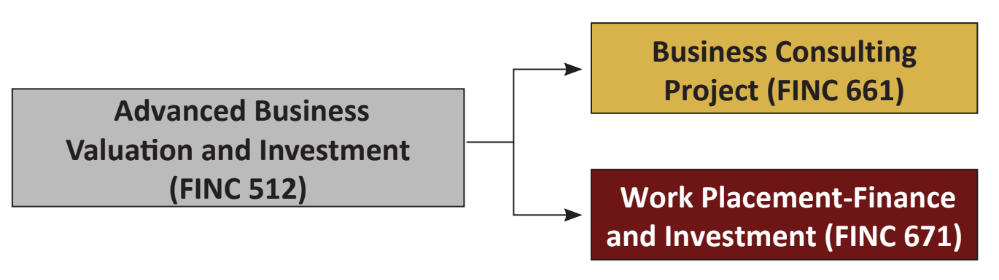
Prerequisites:
There are no prerequisites to this course other than the entrance requirements for the program.
Upon successful completion of this course students should be able to:
| Knowledge | Level of Learning | Related PLO |
|---|---|---|
| Explain the fundamental principles of investment (CK1) Explain the fundamental principles of investment, with a focus on financial markets and institutions, alternative investments techniques available in the global financial markets and formulation of relevant strategies given the investor’s objective. |
Understand | PK1 |
| Explain the process of a robust equity valuation analysis (CK2) Explain the process of a robust equity valuation analysis and the appropriate techniques for valuation and management of equity investments (for a listed and private company). |
Understand | PK1 |
| Explain the CFA Code of Ethics and Standards of Conduct (CK3) Explain the CFA Code of Ethics and Standards of Conduct and the overview of common impact investment strategies across asset classes, including venture capital, private credit, public equities, and real assets. |
Understand | PK1 |
| Cognitive Skills | Level of Learning | Related PLO |
| Evaluate the different approaches (CC1) Evaluate the different approaches to estimating equity investment risk and return and cost of capital from a company’s perspective. |
Evaluate | PC1 |
| Apply discounted cash flow model (CC2) Apply discounted cash flow model in determining the value of a listed and private company. This includes analyzing historical performance, benchmarking and strategic analysis and forecasting free cash flows, identifying source of value, interpretation of results. |
Apply | PC1 |
| Apply market multiples based on comparables (CC3) Apply market multiples based on comparables to perform the market approach to valuation and discuss the rationale for market multiples to value equity. |
Apply | PC1 |
| Communication, Information Technology, and Numerical Skills | Level of Learning | Related PLO |
| Use Microsoft Excel software and other packages (CCIT1) Use Microsoft Excel software and other packages useful for forecasting and analysing financial information. |
Apply | PCIT2 |
| Interpersonal Skills and Responsibilities | Level of Learning | Related PLO |
| Develop teamwork skills (CIP1) | Create | PIP1 |
| Behave ethically as a finance analyst (CIP2) Behave ethically as a finance analyst in accordance with the CFA Code of Ethics. |
Respond | PIP2 |
Grades will be determined based on a grading score, calculated using the following assessments and score allocations:
| Topic | CLO Assessment and Scoring | Total CLO Score | Weighting for Course Grade | |||||
|---|---|---|---|---|---|---|---|---|
| Attendance & Participation | In-class Tests | Homework | Assignments (Stock Valuation) |
Midterm Exam | Final Exam | |||
| Evaluate the different approaches (CC1) | 100% | |||||||
| Explain the process of a robust equity valuation analysis (CK2) | 100% | |||||||
| Explain the CFA Code of Ethics and Standards of Conduct (CK3) | 100% | |||||||
| Evaluate the different approaches (CC1) | 100% | |||||||
| Apply discounted cash flow model (CC2) | 100% | |||||||
| Apply market multiples based on comparables (CC3) | 100% | |||||||
| Use Microsoft Excel software and other packages (CCIT1) | 100% | |||||||
| Develop teamwork skills (CIP1) | 100% | |||||||
| Behave ethically as a finance analyst (CIP2) | 100% | |||||||
During the term there is one Project Assignment:
Business Valuation Assignment
Work Arrangement: Group
Output format : Professional Valuation Report Format, Presentation
Language : English
Assignment : Each team (team of 3-4 students) must prepare a written research report on the
subject company (The subject company can be ABC, PWSA, PPAP, PAS, GTI, PPSEZ,
PEPC or NagaCorp) chosen by the team, which involves an analysis of the ordinary
shares of a publicly listed company. Each team will be required to value the equity
of the chosen company. Each student will be tested on their analytical, valuation,
report writing, and presentation skills.
The course will be delivered as a mix of lectures, class discussion, practice assignments and cases. Some of
the questions on the midterm and final exams will be based on real-life financial statements of well-known
companies.
Class participation grade will be based both on attendance and constructive participation. You are expected
to participate in class discussions and you will be graded on your contribution to the classroom learning
environment. You should expect to be “cold called” to discuss assigned review problems and to offer views
on the assigned material.
The course targets the study plan below but its implementation may vary somewhat depending on the progress and needs of students. Some topics may be allocated more or less than 1.5 hours.
| Lesson Learning Outcomes | Teaching and Learning Activities, Assessment |
|
|---|---|---|
| 1 |
Introduction to the Investment Setting
|
Reading: |
| 2 |
Introduction to the Investment Setting
|
Reading: |
| 3 |
Introduction to the Investment Setting
|
Reading: |
| 4 |
Introduction to the Investment Setting
|
Reading: |
| 5 |
Introduction to Alternative Investments
|
Reading: |
| 6 |
Introduction to Alternative Investments
|
Reading: |
| 7 |
Investment risk and return
|
Reading: |
| 8 |
Investment risk and return
|
Reading: |
| 9 |
Investment risk and return
|
Reading: |
| 10 |
Investment risk and return
|
Reading: |
| 11 |
Investment risk and return
|
Reading: |
| 12 |
Introduction to Valuation: Industry Analysis
|
Reading: |
| 13 |
Introduction to Valuation: Industry Analysis
|
Reading: |
| 14 |
Introduction to Valuation: Industry Analysis
|
Reading: |
| 15 |
Introduction to Valuation: Company Analysis
|
Reading: |
| 16 |
Introduction to Valuation: Company Analysis
|
Reading: |
| 17 |
Introduction to Valuation: Company Analysis
|
Reading: |
| 18 |
Introduction to Valuation: Company Analysis
|
Reading: |
| 19 |
Discounted Dividend Valuation
|
Reading: |
| 20 |
Discounted Dividend Valuation
|
Reading: |
| 21 |
Discounted Dividend Valuation
|
Reading: |
| 22 |
Free Cash Flow Valuation
|
Reading: |
| 23 |
Free Cash Flow Valuation
|
Reading: |
| 24 |
Free Cash Flow Valuation
|
Reading: |
| 25 |
Multiples Valuation
|
Reading: |
| 26 |
Multiples Valuation
|
Reading: |
| 27 |
Multiples Valuation
|
Reading: |
| 28 |
Valuing private company
|
Reading: |
| 29 |
Valuing private company
|
Reading: |
| 30 |
Valuing private company
|
Reading: |
| 31 |
IPO Valuation
|
Reading: |
| 32 |
IPO Valuation
|
Reading: |
| 33 |
Team Exercise: Multiples Valuation
|
|
| 34 |
Team Exercise: Multiples Valuation
|
|
| 35 |
Team Exercise: Multiples Valuation
|
|
| 36 |
Team Exercise: Forecasting Performance
|
|
| 37 |
Team Exercise: Forecasting Performance
|
|
| 38 |
Team Exercise: Estimating WACC
|
|
| 39 |
Team Exercise: Estimating WACC
|
|
| 40 |
Team Exercise: Calculating FCFF and MVE
|
|
| 41 |
Team Exercise: Calculating FCFF and MVE
|
|
| 42 |
Team Exercise: Sensitivity Analysis
|
|
| 43 |
Team Exercise: Sensitivity Analysis
|
|
| 44 | Team Presentations – Complete Report (CK2, CC2, CCIT1, CIP1) |
Team presentations and feedback |
| 45 | Team Presentations – Complete Report (CK2, CC2, CCIT1, CIP1) |
Team presentations and feedback |
| 46 | Team Presentations – Complete Report (CK2, CC2, CCIT1, CIP1) |
Team presentations and feedback |
| 47 | Team Presentations – Complete Report (CK2, CC2, CCIT1, CIP1) |
Team presentations and feedback |
| 48 |
CFA Code of Ethics
|
Reading: |
| 49 |
Global Investment Performance Standards (GIPS)
|
Reading: |
| 50 | Exam Review | |
Textbook
1. CFA Program Curriculum: Equity Investments and Portfolio Management – Level I Part I, CFA
Institute, 2019/2020
2. Damodaran A. (2012). Damodaran on Valuation: Security Analysis for Investment and Corporate
Finance, 2nd Edition, Wiley Finance.
3. Bodie, Kane & Marcus (2019) Investments, 11th Edition, McGraw Hill.
4. Reilly, F. & Brown, K. (2016) Analysis of Investments & Management of Portfolios, 10th Edition,
South-Western, Cengage Learning.
Additional References
1. CFA Institute, Introduction to the Global Investment Performance Standards, 2018.
2. CFA Institute, Global Investment Performance Standards, 2018.
3. CFA Institute, Code of Ethics and Standards of Professional Conduct Standards of Practice
Handbook, Eleventh Edition
4. CFA Institute, Guidance for Standards I–VII Standards of Practice Handbook, Eleventh Edition
5. Videos: https://www.khanacademy.org/economics-finance-domain/core-finance
6. Valuation: Measuring and Managing the Value of Companies, McKinsey & Company: T. Koller, M.
Goehart, and D. Wessels, 5th edition, 2010
7. Investment Valuation: Tools and Techniques for Determining the Value of Any Asset, A. Damodaran,
3rd edition, 2012
8. The Dark Side of Valuation: Valuing Young, Distressed, and Complex Businesses, A. Damodaran, 2nd
edition, 2009
Note: A financial calculator capable of performing operations with amortizing payments and uneven cash
flows (e.g., Texas Instruments BA II Pus, Hewlett Packard 12C, etc.). You could use an app on your smartphone
but it will not be allowed during exams. Please bring your calculator to each class.