
IFRS for SMEs (ACCT 512)

OVERVIEW

1. COURSE DESCRIPTION

This course teaches accounting and financial reporting for individual medium sized businesses of the sort
that would use IFRS for SMEs, complementing the IFRS courses that teach accounting for larger businesses.
In this course, assessments include controlled case studies and a project in which students will prepare an
IFRS for SMEs compliant financial report for a local company.

2. REASON FOR THE COURSE

Accountants must be able to prepare a set of financial statements for a company. In Cambodia, national
regulations require companies to follow either CIFRS or CIFRS for SMEs, which are the same as IFRS and IFRS
for SMEs. Therefore, program graduates will be preparing, auditing, or using financial statements prepared
in accordance with these two standards.

3. STUDY HOURS

4. ROLE IN CURRICULUM
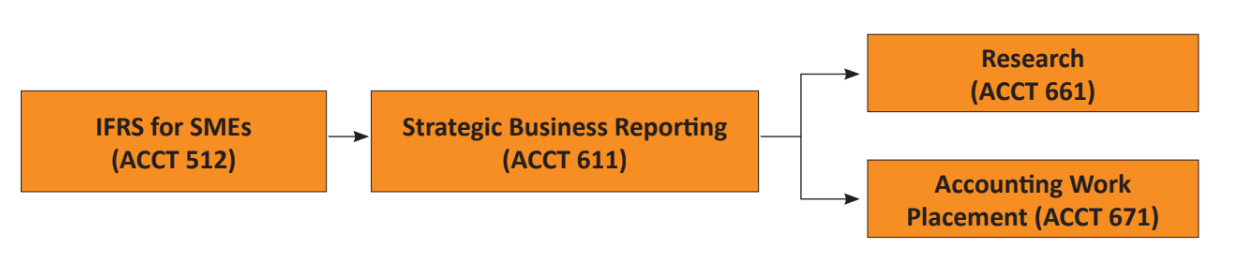

Prerequisites:
There are no prerequisites for this course other than the program entrance requirements.

SKILLS

  • LEARNING OUTCOMES
  • ASSESSMENT AND GRADING
  • TEACHING METHODS
  • STUDY PLAN
  • TEXTBOOKS AND REFERENCES

5. COURSE LEARNING OUTCOMES (CLO)

On successful completion of this course, students will be able to:

Knowledge Level of Learning Related PLO
Describe IFRS for SMEs (CK1)
Describe the objective, applicability and publication of IFRS for SMEs.
Understand PK5
Cognitive Skills Level of Learning Related PLO
Apply IFRS for SMEs (CC1)
Apply IFRS for SMEs to transactions and recognition and measurement assets and liabilities common to SMEs in Cambodia.
Apply PC7
Prepare a Financial Report (CC2)
Prepare a general purpose financial report for an individual business in Cambodia in compliance with IFRS for SMEs.
Create PC7
Communication, Information Technology, and Numerical Skills Level of Learning Related PLO
Prepare a Loan Schedule (CCIT1)
Prepare loan and amortisation schedules based on the effective interest rate using a spreadsheet.
Apply PCIT1
Interpersonal Skills and Responsibilities Level of Learning Related PLO
Work Ethically (CIP1)
Resolve threats to the ACCA Code of Ethics and Conduct.
Characterize PIP3

6. ASSESSMENT AND GRADING

Grades will be determined based on the following assessments and score allocations:

SKILL Assessment Skill
Weighting
for Grade
Participation Project Controlled
Case Studies
Final
Controlled
Case Study
Describe IFRS for SMEs (CK1) 100% 5%
Apply IFRS for SMEs (CC1) 40% 60% 50%
Prepare a Financial Report (CC2) 75% 25% 30%
Prepare a Loan Schedule (CCIT1) 100% 5%
Work Ethically (CIP1) 100% 10%


7. TEACHING METHODS

This course uses demonstration, lecture, case studies, and group problem solving. Approximately 1/2 of the
class time will be demonstrations, presentations and questioning (often using Kahoot!) from the lecturer,
with the other 1/2 of the class for working on case studies and problem sets. Case studies and problem sets
are delivered via Google Classroom Quiz and Google Sheets.

During the course, there is one Project:

IFRS for SMEs Financial Reporting Project

Work Arrangement: Groups of two
Output format : IFRS for SMEs format Financial Report
Language : English and Khmer
Assignment : Students prepare a set of financial statements in compliance with IFRS for SMEs (to
the extent possible given constraints and available data) for a small or medium sized
business or not-for-profit organization in Cambodia. The financial report will cover a
period of two years. Drafts and a final report will be first written in English followed
by a Khmer translation. Scoring will be according to the Assignment Rubric

8. STUDY PLAN

The course targets the 50 lessons in the study plan below. Each lesson is 1.5 class hours each; there are a total of 75 class hours. The study plan below describes the learning outcome for each lesson, described in terms of what the student should be able to do at the end of the lesson. Readings should be done by students as preparation before the start of each class. Implementation of this study plan may vary somewhat depending on the progress and needs of students.

  Lesson Learning Outcomes Teaching and Learning Activities, Assessment
1 Small and Medium-Sized Entities

  1. Distinguish between entities that may and may not apply IFRS for SMEs (CK1)
  2. Describe the components of a financial report prepared in accordance with IFRS for SMEs (CC2)
  3. Explain the advantages of IFRS for SMEs compared to IFRS (CK1)
  • Lecture
  • Kahoot

Reading:
IFRS for SMEs, Preface pp 6-9, Section 1 pp 10-12, Section 3 pp 22-26

Reference: Modules 1, 3

2 Statement of Financial Position

  1. Organize accounts in a statement of financial position according to IFRS for SMEs’ format (CC2)
  2. Prepare a statement of financial position in accordance with IFRS for SMEs (CC2)
  • Lecture
  • Group case study
  • Discussion

Reading:
IFRS for SMEs, Section 4 pp 27-30

Reference: Modules 4

3 Statement of Comprehensive Income

  1. Explain the acceptable formats and classification in the statement of income or statement of retained earnings (CK1)
  2. Classify expenses by nature and function (CC2)
  • Lecture
  • Group case study
  • Discussion
  • Kahoot

Reading:
IFRS for SMEs, Section 5 pp 31-33, Section 6 34-35

Reference: Module 5

4 Concepts and Pervasive Principles, Notes to the Financial Statements

  1. Describe the pervasive principles of IFRS for SMEs (CK1)
  2. Explain how the objective of IFRS for SMEs influences application of IFRS for SMEs (CK2)
  3. Identify the role, components and location of notes within the financial report (CC2)
  4. Distinguish between relevant and irrelevant information for decision making in notes (CC2)
  • Lecture
  • Kahoot

Reading:
IFRS for SMEs, Section 2 pp 12-13, 18, Section 8 pp 41-42, Section 10 page 50

Reference: Module 8

5 ACCA Code of Ethics and Conduct

  1. Describe the fundamental principles the ACCA Code of Ethics and Conduct (CIP1)
  2. Apply the fundamental principles of the ACCA Code of Ethics and Conduct to resolve ethical dilemmas arising in financial reporting (CIP1)
  • Group case study
  • Kahoot

Reading:
ACCA Code of Ethics and Conduct, pp 18-23

Reference: ACCA Code of Ethics and Conduct pp 24-31

6 Accounting Policies, Estimates and Errors

  1. Define and distinguish changes in accounting policies, changes in estimates, and errors (CK1)
  2. Determine the correct way to report changes in accounting policies, changes in estimates and errors (CC2)
  • Lecture
  • Group case study

Reading:
IFRS for SMEs, Section 10 pp 50-54

Reference: Module 10

7 Basic Financial Instruments

  1. Describe the types of financial instruments covered by IFRS for SMEs 11. (CK1)
  2. Calculate the amount a financial instrument should be recorded on initial recognition. (CC1)
  • Lecture
  • Group case study

Reading:
IFRS for SMEs, Section 11 pp 55-59

Reference: Module 11

8 Basic Financial Instruments – Bad Debts

  1. Estimate bad debts for a company (CC1)
  2. Prepare the journal entries to account for bad debts (CC1)
  3. Prepare the disclosure note for receivables (CC2)
  • Lecture
  • Group case study

Reading:
IFRS for SMEs, Section 11 pp 62-65

Reference: Module 11

9 Controlled Case Study 1

  1. Review and assess learning outcomes lecture 1-8
  • Controlled case study
10 Accounting for Loans Payable

  1. Prepare an amortisation schedule for a loan using Excel (CCIT1)
  2. Prepare the journal entries for a loan. (CC1)
  • Demonstration using Excel
  • Group case study using Excel

Reading:
IFRS for SMEs, Section 11 pp 60-62

Reference: Module 11

11 Accounting for Loans Payable – Effective Interest Rate

  1. Calculate the effective interest rate using Excel or Google Sheets (CCIT1)
  2. Account for borrowing costs in accordance with section 25 (CC1)
  3. Prepare the disclosure note for loans payable (CC2)
  • Demonstration of the amortized cost method using Excel
  • Group problems using Excel
  • Discussion

Reading:
IFRS for SMEs, Section 11, pp 60-62, 68-70

Reference: Module 11

12 Other Financial Instrument Issues- Equity Instruments

  1. Identify and account for equity instruments (CC1)
  2. Identify and account for investments in associates (CC1)
  • Demonstration using Excel
  • Group problems using Excel

Reading:
IFRS for SMEs, Section 11 pp 59, 60, IFRS for SMEs, Section 14 pp 84-87

Reference: Module 11, Module 14

13 Business and Industry Analysis – Porter’s Five Forces

  1. Prepare a business analysis using Porter’s Five Forces and sources of competitive advantage. (CC2)
  • Lecture
  • Discussion
  • Presentation

Reading:
Harvard Business Review, pp 25-39

14 Inventories

  1. Determine the components of cost to include in inventory (CC1)
  2. Distinguish between normal and abnormal costs (CC1)
  • Lecture
  • Group problems
  • Discussion

Reading:
IFRS for SMEs, Section 13 pp 79-81

Reference: Module 13

15 Inventories

  1. Determine inventory cost using the FIFO periodic method (CC1)
  2. Record cost of goods sold following both expense by nature and expense by function (CC1)
  3. Prepare a disclosure note for inventories (CC2)
  • Demonstration
  • Group problems
  • Discussion

Reading:
IFRS for SMEs, Section 13 pp 82-83

Reference: Module 13

16 Specialised Activities – Biological Assets

  1. Prepare the journal entries to account for biological assets (CC1)
  2. Account for the harvested product of biological assets (CC1)
  • Lecture
  • Group problems
  • Discussion

Reading:
IFRS for SMEs, Section 34 pp 208-210

Reference: Module 34

17 Specialised Activities – Service Concessions

  1. Identify a service concession agreement (CC1)
  2. Account for income and costs related to service concession agreements (CC1)
  • Class case study
  • Group problems
  • Discussion

Reading:
IFRS for SMEs, Section 34 pp 211-212

Reference: Module 34

18 Controlled Case Study 2

  1. Review and assess learning outcomes lecture 10-17
  • Controlled case study
19 Investment Property

  1. Distinguish between investment property and other types of property (CC1)
  2. Record the gains and losses related to investment property (CC1)
  3. Prepare a disclosure note for investment property (CC2)
  • Lecture
  • Group problems
  • Discussion

Reading:
IFRS for SMEs, Section 16 pp 92-94

Reference: Module 16

20 Property, Plant and Equipment

  1. Calculate depreciation for property, plant and equipment (CC1)
  2. Determine gains and losses on disposal (CC1)
  • Demonstration
  • Group problems
  • Discussion

Reading:
IFRS for SMEs, Section 17 pp 95-101

Reference: Module 17

21 Property, Plant and Equipment

  1. Account for renovation of property, plant and equipment (CC1)
  2. Account for revaluation of property classified as property, plant and equipment (CC1)
  3. Prepare a disclosure note for property, plant and equipment (CC2)
  • Demonstration
  • Group problem based learning
  • Discussion

Reading:
IFRS for SMEs, Section 17 pp 95-101

Reference: Module 17

22 Intangible Assets other than Goodwill

  1. Record the purchase or development of software (CC1)
  2. Calculate the amortisation of intangible assets with change in estimated useful life (CC1)
  • Lecture
  • Group problem based learning
  • Kahoot

Reading:
IFRS for SMEs, Section 18 pp 102-106

Reference: Module 18

23 Impairment of Assets

  1. Explain when impairment needs to be tested (CC1)
  2. Determine the recoverable amount of a potentially impaired asset (CC1)
  3. Explain why it may not be necessary to determine value in use (CC1)
  • Didactic questioning
  • Group problems
  • Discussion
  • Kahoot

Reading:
IFRS for SMEs, Section 27 pp 163-170

Reference: Module 27

24 Impairment of Assets

  1. Calculate impairment expense of an individual asset (CC1)
  • Case study
  • Group problem
  • Discussion

Reading:
IFRS for SMEs, Section 27 pp 163-170

Reference: Module 27

25 Leases

  1. Distinguish between operating leases and finance leases (CC1)
  2. Account for operating leases, including transaction costs and discounts (CC1)
  3. Prepare a disclosure note for operating leases (CC2)
  • Lecture
  • Group problem
  • Kahoot

Reading:
IFRS for SMEs, Section 20 pp 113-120

Reference: Module 20

26 Leases

  1. Determine the appropriate interest rate to be used with a given finance lease (CC1)
  2. Prepare an amortisation schedule for payments and expense under a finance lease (CCIT1)
  • Lecture
  • Group problem
  • Discussion

Reading:
IFRS for SMEs, Section 20 pp 113-120

Reference: Module 20

27 Leases

  1. Prepare the journal entries for a finance lease (CC1)
  2. Calculate the current and non-current portions of a finance lease lease liability (CC1)
  • Demonstration using Google Sheets
  • Group problems w/ Google Sheets
  • Kahoot

Reading:
IFRS for SMEs, Section 20 pp 113-120

Reference: Module 20

28 Leases

  1. Prepare the disclosure notes for leases (CC2)
  2. Prepare a statement of financial position, including lease liabilities (CC2)
  3. Prepare a disclosure note for finance leases (CC2)
  • Demonstration using Excel
  • Group problems using Excel
  • Case study

Reading:
IFRS for SMEs, Section 20 pp 113-120

Reference: Module 20

29 Provisions and Contingencies

  1. Explain the definition of provision and contingent liability (CK2)
  2. Determine the amount and appropriate presentation of a provision (CC1)
  3. Recommend a method of estimating a year end warranty provision (CC1)
  4. Prepare the journal entries to record a warranty and annual adjustment thereto (CC1)
  5. Prepare a disclosure note for provisions and contingencies (CC2)
  • Lecture
  • Group problems
  • Kahoot

Reading:
IFRS for SMEs, Section 21 pp 121-124

References: IFRS for SMEs, Section 21 Appendix pp 125-129; Module 21

30 Controlled Case Study 3

  1. Review and assess learning outcomes lecture 23-29
  • Controlled case study
31 Revenue

  1. Explain the recognition criteria for revenue (CC1)
  2. Account for revenue for sale of goods and services (CC1)
  • Lecture
  • Group case study
  • Kahoot

Reading:
IFRS for SMEs Section 23 pp 140-154

Reference: Module 23

32 Revenue

  1. Account for deferred income (CC1)
  2. Identify the revenue attributable to services in a bundle of goods and services (CC1)
  • Case study
  • Kahoot

Reading:
IFRS for SMEs Section 23 pp 140-154

Reference: Module 23

33 Revenue

  1. Describe the methods used to account for construction contracts (CC1)
  2. Prepare the journal entries to record a construction contract using the input method (CC1)
  3. Prepare a statement of profit or loss, including revenue (CC2)
  • Lecture
  • Group problems
  • Discussion

Reading:
IFRS for SMEs Section 23 pp 140-154

Reference: Module 23

34 Employee Benefits

  1. Account for basic employee benefits and the related withholding tax (CC1)
  2. Determine the withholding tax component of employee benefits (CC1)
  • Lecture
  • Discussion

Reading:
IFRS for SMEs, Section 28 pp 171-172

Reference: Module 28

35 Employee Benefits

  1. Identify long term bonuses and other long term employee benefits that should be accrued (CC1)
  2. Account for long term bonuses (CC1)
  • Lecture
  • Demonstration
  • Case study

Reading:
IFRS for SMEs, Section 28 pp 178-179

Reference: Module 29

36 Income Tax

  1. Prepare the journal entries to prepayment of income tax (tax on profit) (CC1)
  2. Prepare the journal entries to record withholding taxes that can be deducted from income tax (tax on profit) (CC1)
  3. Prepare the year-end journal entry to record income tax payable (tax on profit) (CC1)
  4. Prepare a statement of profit or loss, including tax (CC2)
  • Lecture
  • Case study
  • Group problem based learning
  • Discussion

Reading:
IFRS for SMEs, Section 29 pp 182, 189

Reference: Module 29

37 Income Tax

  1. Distinguish between the carrying amount of net assets and the tax base of net assets (CC1)
  2. Calculate the taxable and deductible differences arising from temporary differences (CC1)
  • Demonstration
  • Case study
  • Group problem based learning
  • Discussion

Reading:
IFRS for SMEs, Section 29 pp 183-186, 188-189

Reference: Module 29

38 Income Tax

  1. Prepare the journal entries to record income tax expense, including adjustments to deferred tax (CC1)
  2. Prepare a statement of financial position, including liabilities for current tax and deferred tax (CC2)
  3. Prepare a disclosure note for income tax and deferred tax (CC2)
  • Demonstration
  • Case study
  • Group problem based learning
  • Discussion

Reading:
IFRS for SMEs, Section 29 pp 189-191

Reference: Module 29

39 Controlled Case Study 3

  1. Review and assess learning outcomes lecture 31-38
  • Controlled case study
40 Cash Flow Statements

  1. Define cash and cash equivalents (CK2)
  2. Explain the difference between the direct and indirect methods of preparing a cash flow statement (CC1)
  3. Explain the meaning of operating cash flows, investing cash flows, and financing cash flows (CC2)
  4. Prepare the operating cash flow portion of a cash flow statement (CC2)
  • Didactic questioning
  • Discussion

Reading:
IFRS for SMEs, Section 7 pp 36-40

Reference: Module 7

41 Cash Flow Statements

  1. Prepare the investing and financing portions of a cash flow statement (CC2)
  2. Present exchange rate changes in foreign currency cash and cash equivalents in the cash flow statement (CC2)
  • Demonstration
  • Group problem based learning
  • Discussion

Reading:
IFRS for SMEs, Section 7 pp 36-40

Reference: Module 7

42 Cash Flow Statements

  1. Prepare a full cash flow statement (CC2)
  • Case study
  • Discussion

Reading:
IFRS for SMEs, Section 7 pp 36-40

Reference: Module 7

43 Foreign Currency Translation

  1. Determine the appropriate exchange rate to record foreign currency income, expense, assets, liabilities (CC2)
  2. Record gains and losses arising from remeasurement and settlement of foreign currency receivables and payables (CC2)
  • Lecture
  • Demonstration
  • Group problems
  • Discussion

Reading:
IFRS for SMEs, Section 30 pp 192-194

Reference: Module 30

44 Foreign Currency Translation

  1. Explain the concept of functional currency (CK1)
  2. Explain the purpose of a presentation currency (CC2)
  3. Prepare a disclosure note for functional currency and presentation currency (CC1)
  4. Prepare a disclosure note for a presentation currency that is not in compliance with the IFRS for SMEs presentation currency (CC2)
  • Lecture
  • Case study
  • Group problems
  • Discussion

Reading:
IFRS for SMEs, Section 30 pp 195-197

Reference: Module 30

45 Related Party Disclosures

  1. Define a related party according to IFRS for SMEs (CK1)
  2. Identify transactions with a related party that would warrant disclosure in the notes (CC2)
  3. Prepare a related party disclosure note (CC2)
  • Didactic questioning
  • Group problems
  • Discussion

Reading:
IFRS for SMEs, Section 33 pp 204-207

Reference: Module 33

46 Transition to the IFRS for SMEs

  1. Define first time application of IFRS for SMEs (CK2)
  2. Describe the additional disclosures required when an entity applies IFRS for SMEs for the first time (CK2, CC2)
  3. Explain the simplifications allowed on transition to IFRS for SMEs (CK2)
  4. Prepare a full set of financial statements for an entity that transitions to IFRS for SMEs for the first time (CC2)
  • Lecture
  • Case study
  • Group problem based learning
  • Discussion

Reading:
IFRS for SMEs, Section 35 pp 213-218

Reference: Module 35

47 Review and preparation for final exam Lecture
48 Review and preparation for final exam Lecture
49 Student Presentations – Small Groups Presentation
50 Student Presentations – Finalists Presentation
Total Hours: 75 hours


9. TEXTBOOKS AND REFERENCES

Textbooks

1. IFRS Foundation, IFRS for SMEs 2015, IFRS Foundation 2015.
2. Association of Chartered Certified Accounts, Code of Ethics and Conduct, Association of Chartered
Certified Accountants, 2020.
3. Porter, ME, The Five Competitive Forces that Shape Strategy, Harvard Business Review, January
2008

References

1. IFRS Foundation, IFRS for SMEs Education Modules, IFRS Foundation 2015 – 2018
2. Makenzie, Bruce, Tapiwa Njikizana, et all, Applying IFRS for SMEs, Wiley, 2011.