
1. COURSE DESCRIPTION
This course aims to develop advanced level knowledge and skills relating to the Cambodian tax system as
applicable to individuals and companies. The course on basic Cambodian Tax (ACCT 551) is a prerequisite
for this subject as this course aims to leverage the basic tax knowledge gained under ACCT 551 and apply
these into practice and case studies.
This course is also suitable for tax professionals, providing tax services in Cambodia as a tax agent, advisor,
or as an employee handling the tax compliance requirements of the business. There are four main goals:
First, students will use the advanced knowledge gained from the class to make detailed analysis as to what
Cambodian tax(es) applies to non-routine and complex transactions carried out in Cambodia. Second,
students will be able to determine the tax liabilities and how to remit the taxes to the Cambodian tax
authority. Third, students will be able to apply the knowledge gained on making tax planning techniques for
individuals and companies. Fourth, students will be able to analyze and prepare strategies for managing tax
issues, including managing the tax risk during tax audit events.
2. REASON FOR THE COURSE
This course introduces candidates to the subject of taxation and provides broadened and deepened
knowledge and skills relating to Cambodia taxation, as they affect the activities of individuals and businesses.
In this course, candidates are introduced to the rationale behind and the functions of the tax system. The
course then considers the separate taxes that an accountant and consultants would need to have a deeper
knowledge of corporation tax liability withholding tax, and the value added tax liability as well as capital
gain tax, double taxation agreements (DTA), transfer pricing rules, tax audit and protest procedures.
The Cambodian tax system is still developing and personal income tax has been introduced in Cambodia
under 2019 Financial Law but it has not yet been implemented. However, the Capital Gains Tax, which is a
part of personal income tax, will be discussed in detail in this course on how it impacts individuals. In addition,
withholding tax is one of the mechanisms used by the governments of the developing countries to collect
tax revenue from non-tax registered persons, and Cambodia is no exception. However, the withholding
tax rate will be adjusted for residents of countries that have a DTA with Cambodia. In such circumstances,
candidates develop knowledge and skills in regards to “withholding tax as well as tax reductions under
the DTAs”. Furthermore, the course will introduce a transfer pricing method used by the multi-national
companies for related party transactions.
Having covered the core areas and in-depth analysis of the Cambodia taxes, the candidate should be able
to identify tax issues impacting individuals and companies, compute tax liabilities, and manage tax planning
techniques for that individual and companies.
3. STUDY HOURS

4. ROLE IN CURRICULUM
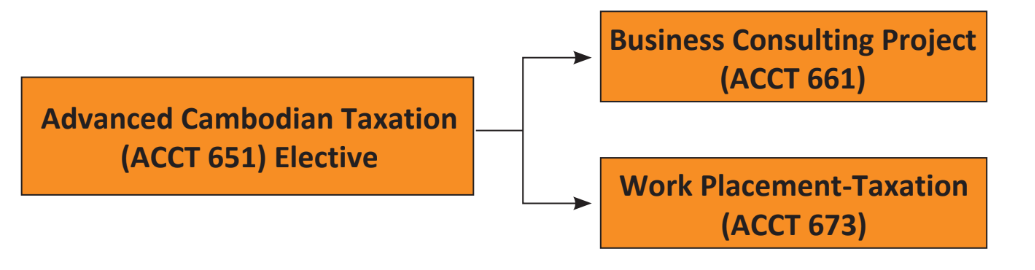
Prerequisites:
Students must have successfully completed Cambodian Tax (ACCT 551) and passed the Diploma in
Cambodian Tax exam.
On successful completion of this course, students will be able to:
| Knowledge | Level of Learning | Related PLO |
|---|---|---|
| Explain Cambodian Tax System (CK1) Explain the scope and operations of the Cambodian tax system, integrating knowledge from previous tax studies. |
Understand | PK1 |
| Cognitive Skills | Level of Learning | Related PLO |
| Apply Tax Liabilities in Cambodia (CC1) Evaluate monthly tax returns and tax on income for business in Cambodia in compliance with Cambodian tax law and regulations. |
Evaluate | PC4 |
| Communication, Information Technology, and Numerical Skills | Level of Learning | Related PLO |
| (None) | ||
| Interpersonal Skills and Responsibilities | Level of Learning | Related PLO |
| Discuss Tax Implications (CCIT1) Discuss on tax issue with tax officers |
Respond | PC4 |
Grades will be determined based on a grading score, calculated using the following assessments and score allocations:
Grades will be determined based on the following assessments and score allocations:
| SKILL | Assessment | Skill Weighting for Grade |
||
|---|---|---|---|---|
| Quiz | Tax Simulation | Final Exam | ||
| Explain Cambodian Tax System (CK1) | 100% | 10% | ||
| Apply Tax Liabilities in Cambodia (CC1) | 20% | 40% | 40% | 70% |
| Discuss Tax Implications (CCIT1) | 50% | 50% | 20% | |
This course is primary lecture and assignment based; assigned readings will support learning and serve as
a reference to materials covered in class. During class, approximately one hour and 45 minutes of the total
class will be devoted to lecture with another 45 minutes of the class will be for practices and quizzes.
Tax Simulation 1 : Group (Monthly Tax Declaration)
Tax Simulation 2 : Group (Annual Tax on Income)
The course targets the 50 sessions in the study plan below. Each session is 1.5 class hours each; there are a total of 75 class hours. The study plan below describes the learning outcome for each lesson, described in terms of what the student should be able to do at the end of the lesson. Readings should be done by students as preparation before the start of each class. Implementation of this study plan may vary somewhat depending on the progress and needs of students.
| Lesson Learning Outcomes | Teaching and Learning Activities, Assessment |
|
|---|---|---|
| 1 |
Cambodian Tax System and Administration |
Reading: Law on Taxation (LoT) chapter 1, LoT (Article 29-32) Order (Prakas) No. 009 MEF.Prk on Classification of Taxpayers under the SAR |
| 2 |
Tax on Salary 1 |
Reading: Order (Prakas) No. 543 on Tax |
| 3 |
Tax on Salary (ToS) 1 |
Reading: Order (Prakas) No. 543 on Tax on Salary, |
| 4 |
Withholding Tax (WHT) 1 |
Reading: Law on Taxation (Article 25-27, 33-35, 38-39, and 88) Order (Prakas) No. 098 Tax on Income (Article 5, 7 & 45-50) |
| 5 |
Withholding Tax (WHT) 2 |
Reading: Law on Taxation (Article 25-27, 33-35, 38-39, and 88) Order (Prakas) No. 098 Tax on Income (Article 7 & 45-50) Relevant DTA agreements between Cambodia and partner countries • Effective from 1 January 2018: Singapore and Thailand • Effective from 1 January 2019: China, Brunei and Vietnam • Effective from 1 January 2020: Hong Kong • Effective from 1 January 2021: Indonesia and Malaysia • Effective from 1 January 2022: Republic of Korea • Entered the agreement on 23 April 2021: Macau • Entered the agreement on 27 February Explore: UN-iLibrary at https://www.un- |
| 6 |
Withholding Tax (WHT) 2
|
Reading: Law on Taxation (Article 25-27, 33-35, 38-39, and 88), Order (Prakas) No. 098 Tax on Income, Relevant DTA agreements between Cambodia and partner countries |
| 7 |
Withholding Tax (WHT) 3
|
Reading: Law on Taxation (Article 25-27, 33-35, 38-39, and 88), Order (Prakas) No. 098 Tax on Income, Order No. 372.MEF.Prk, Article 12A and other comments for Technical Services |
| 8 |
Withholding Tax (WHT) 4
|
Reading: Law on Taxation (Article 25-27, 33-35, 38-39, and 88), Order (Prakas) No. 098 Tax on Income, Instruction No. 4084.GDT, Instruction 020.MEF, Relevant DTA agreements |
| 9 |
Value Added Tax (VAT) 1
|
Reading: Law on Taxation, Section 3, Art 55-84; Sub-Decree 114 on Value Added Tax; Order (Prakas) No. 559.MEF.Prk; Instruction No. 1280.GDT |
| 10 |
Value Added Tax (VAT) 2
|
Reading: Law on Taxation, Section 3, Art 55-84; Instruction No. 9888 GDT; Sub-Decree 114 on Value Added Tax |
| 11 |
Value Added Tax (VAT) 3
|
Reading: Law on Taxation, Section 3, Art 55-84; Sub-Decree 65; Prakas 542.MEF.Prk; Instruction No. 20522.GDT; FAQ and related VAT on E-commerce instructions |
| 12 |
Value Added Tax (VAT) 3
|
Reading: Law on Taxation, Section 3, Art 55-84; Sub-Decree 65; Prakas 542.MEF.Prk; Instruction No. 20522.GDT; FAQ and related VAT on E-commerce instructions |
| 13 |
Value Added Tax (VAT) 4
|
Reading: Sub-Decree 114 on Value Added Tax; Instruction No. 15301 GDT; Instruction No. 12093 GDT; Order (Prakas) No. 597.MEF.Prk |
| 14 |
Value Added Tax (VAT) 4
|
Reading: Sub-Decree 114 on Value Added Tax; Instruction No. 15301 GDT; Instruction No. 12093 GDT; Order (Prakas) No. 597.MEF.Prk |
| 15 |
Tax on Income (ToI) 1
|
Reading: Law on Taxation, Chapter 1, Provision for the Tax on Income; Order (Prakas) No. 098 MEF Tax on Income |
| 16 |
Tax on Income (ToI) 2
|
Reading: Order (Prakas) No. 098 MEF Tax on Income; Prakas No. 346.MEF.Prk; Notification No. 4577.GDT |
| 17 |
Tax on Income (ToI) 2
|
Reading: Order (Prakas) No. 098 MEF Tax on Income; Prakas No. 346.MEF.Prk; Notification No. 4577.GDT |
| 18 |
Tax on Income (ToI) 3
|
Reading: Law on Taxation, Chapter 1, Provision for the Tax on Income; Order (Prakas) No. 098 MEF Tax on Income; Prakas No. 453.MEF.Prk |
| 19 |
Tax on Income (ToI) 3
|
Reading: Law on Taxation, Chapter 1, Provision for the Tax on Income; Order (Prakas) No. 098 MEF Tax on Income; Prakas No. 453.MEF.Prk |
| 20 |
Tax on Income (ToI) 4
|
Reading: Law on Taxation, Chapter 1, Provision for the Tax on Income; Order (Prakas) No. 098 MEF Tax on Income; IAS 12 Income Taxes |
| 21 |
Tax on Income (ToI) 4
|
Reading: Law on Taxation, Chapter 1, Provision for the Tax on Income; Order (Prakas) No. 098 MEF Tax on Income; IAS 12 Income Taxes |
| 22 |
Tax on Income (ToI) 4
|
Reading: Law on Taxation, Chapter 1, Provision for the Tax on Income; Order (Prakas) No. 098 MEF Tax on Income; IAS 12 Income Taxes |
| 23 | In class tests |
|
| 24 |
Tax on Income (ToI) 5
|
|
| 25 |
Tax on Income (ToI) 6
|
Reading: Law on Taxation, Chapter 1; Prakas No. 87-017-344; Prakas No. 1535.MEF.PrK |
| 26 |
Tax on Income (ToI) 6
|
Reading: Law on Taxation, Chapter 1; Prakas No. 87-017-344; Prakas No. 1535.MEF.PrK |
| 27 |
Tax on Income (ToI) 7
|
Reading: Law on Taxation, Chapter 1; Prakas No. 490; Insurance payment tax rules |
| 28 |
Tax on Income (ToI) 8
|
Reading: Law on Taxation; New Law on Investment 2021; Sub-Decree No. 33 |
| 29 |
Tax on Income (ToI) 9
|
Reading: Law on Taxation, Chapter 1; Order (Prakas) No. 098 MEF; Order (Prakas) No. 217.MEF.PrK |
| 30 |
Tax on Income (ToI) 10
|
Reading: Law on Taxation, Chapter 1; Instruction No. 4091 GDT; Order (Prakas) No. 098 MEF Tax on Income |
| 31 |
Tax on Income (ToI) 10
|
Reading: Law on Taxation, Chapter 1; Instruction No. 4091 GDT; Order (Prakas) No. 098 MEF Tax on Income |
| 32 |
Transfer Pricing (TP) 1
|
Reading: OECD Transfer Pricing Guidelines; Order (Prakas) on Rules and Procedure for Allocation of Income and Expenses Among Related Parties, Order (Prakas) No. 986 MEF.BK |
| 33 |
Transfer Pricing (TP) 1
|
Reading: OECD Transfer Pricing Guidelines; Order (Prakas) No. 986 MEF.BK |
| 34 |
Transfer Pricing (TP) 2
|
Reading: Order (Prakas) No. 986 MEF.BK; Circular No. 1707; Instruction No. 151; Instruction No. 11946; Instruction No. 4909; Instruction No. 10979 |
| 35 |
Transfer Pricing (TP) 2
|
Reading: Order (Prakas) No. 986 MEF.BK; Circular No. 1707; Instruction No. 151; Instruction No. 11946; Instruction No. 4909; Instruction No. 10979 |
| 36 | In class tests |
|
| 37 |
Discuss Comprehensive Case Studies 1:
2: Third party vs. related party
|
|
| 38 |
Discuss Comprehensive Case Study 2:
2. Debt vs Equity
|
Reading: Order (Prakas) No. 986 MEF.BK; Instruction No. 10979 GDT on supporting documents for interest between related parties |
| 39 |
Discuss Comprehensive Case Study 2:
2. Debt vs Equity
|
Reading: Order (Prakas) No. 986 MEF.BK; Instruction No. 10979 GDT |
| 40 | In class test |
|
| 41 |
Tax Audit and Protest Procedure 1
|
Reading: Order (Prakas) on Tax Audit, Order (Prakas) No. 270 MEF.BK.TD, all. |
| 42 |
Tax Audit and Protest Procedure 2
|
Reading: Order (Prakas) on Tax Audit, Order (Prakas) No. 270 MEF.BK.TD, all; Order No. 1470.MEF.Prk; Instruction No. 3734.GDT |
| 43 |
Tax Audit and Protest Procedure 2
|
Reading: Order (Prakas) on Tax Audit, Order (Prakas) No. 270 MEF.BK.TD, all; Order No. 1470.MEF.Prk; Instruction No. 3734.GDT |
| 44 | Tax Planning: Business Expansion Case Study Case Study | |
| 45 | Tax Planning: Construction Projects Case Study | |
| 46 | Tax Planning: Manufacturing/Trading/QIP Case Study | |
| 47 | Tax Simulation | |
| 48 | Tax Simulation | |
| 49 | Tax Simulation | |
| 50 | Tax Simulation | |
| Total Hours 75 hours | ||
Textbook
1. Law on Taxation, promulgated by Royal Kram No. NS/RKM/0297/03 dated
February 24, 1997, and its Amendments.
2. Order (Prakas) No. 009 MEF.Prk on Classification of Taxpayers under the SAR
3. Order (Prakas) No. 543 on Tax on Salary
4. Sub-decree No. 196 on Annual Income Tax and Monthly Salary Tax Thresholds,
5. Order (Prakas) No. 098 Tax on Income
6. Relevant DTA agreements between Cambodia and partner countries
7. Order (Prakas) No. 372.MEF.Prk on amendment of instruction on implementation of withholding
tax on dividend distribution (i.e., Prakas No. 518.MEF.Prk)
8. Explore:OECD website at https://www.oecd.org/
9. Explore: UN-iLibrary at https://www.un-ilibrary.org/
10. Instruction No. 4084.GDT on the rule and procedure to implement DTA
11. Instruction 020.MEF on the procedure for apply E-DTA requests
12. Order (Prakas) No. 559.MEF.PrK on the implementation of VAT for non-taxable supply
13. Instruction No. 1280.GDT on Rules and Procedures for adjusting VAT amount after the time of
supply or issuance of invoices.
14. Instruction No. 9898 GDT on supporting documents as evidence of supply of services for uses
outside of the Kingdom of Cambodia subject to VAT at zero percent rate
15. Sub-Decree 114 on Value Added Tax, all
16. Sub-Decree 65, dated 8 April 2021 VAT on E-commerce
17. Prakas 542.MEF.PrK dated 8 September 2021- on rules and procedures for implementation of VAT
on E-commerce transactions
18. Instruction No. 20522.GDT dated 8 December 2021- on implementing the VAT on E-commerce
transactions
19. Frequently Asked Questions (FAQ) for implementing the VAT on E-commerce transactions
20. Instruction No. 6900.GDT dated 8 April 2022-on VAT reverse charge thru E-filing system
21. Instruction No. 15301 GDT on Implementation of Value Added Tax on Sale of Tangible Fixed Assets
22. Instruction no. 12093 GDT on Additional guideline for Implementation of Value Added Tax (VAT) on
Tangible Fixed Asset (FA)
23. Order (Prakas) No. 597.MEF.PrK on recognition and tax obligations of agents supplying goods or
services on behalf of principal enterprises
24. Instruction No. 4091 GDT on the implementation of the instruction to fill the ToI form.
25. OECD Transfer Pricing Guidelines for Multinational Enterprises and Tax Administrations
2022, Chapter I https://read.oecd-ilibrary.org/taxation/oecd-transfer-pricing-guidelines-for-multinational-enterprises-and-tax-administrations-2022_0e655865-en#page9
26. Order (Prakas) on Rules and Procedure for Allocation of Income and Expenses Among Related
Parties, Order (Prakas) No.986 MEF.BK, all.
27. Instruction No. 10979 GDT on supporting documents for interest between related parties
28. Order (Prakas) on Tax Audit, Order (Prakas) No. 270 MEF.BK.TD, all.
29. Notification No. 4577.GDT dated 9 March 2022 on the extension of CGT implementation
30. Circular No. 1707 on the rules on the recognition of debt and interest dated October 2013
31. Instruction No. 151 on the determination of interest expense of enterprises dated 22 January 2014
32. Instruction No. 11946 on interest rules for related party loan dated 21 August 2018
33. Instruction No. 4909 on supporting documents of interest rate between the related parties dated
18 March 2019
34. IAS 12 Income Taxes: https://www.ifrs.org/issued-standards/list-of-standards/ias-12-income-taxes/