
1. COURSE DESCRIPTION
This course teaches accounting and financial reporting for individual medium sized businesses of the sort
that would use IFRS for SMEs, complementing the IFRS courses that teach accounting for larger businesses.
In this course, assessments include controlled case studies and a project in which students will prepare an
IFRS for SMEs compliant financial report for a local company.
2. REASON FOR THE COURSE
Accountants must be able to prepare a set of financial statements for a company. In Cambodia, national
regulations require companies to follow either CIFRS or CIFRS for SMEs, which are the same as IFRS and IFRS
for SMEs. Therefore, program graduates will be preparing, auditing, or using financial statements prepared
in accordance with these two standards.
3. STUDY HOURS

4. ROLE IN CURRICULUM
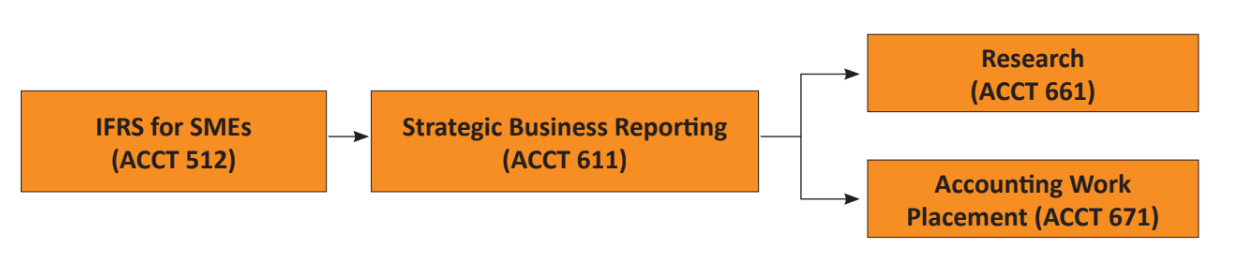
Prerequisites:
There are no prerequisites for this course other than the program entrance requirements.
On successful completion of this course, students will be able to:
| Knowledge | Level of Learning | Related PLO |
|---|---|---|
| Describe IFRS for SMEs (CK1) Describe the objective, applicability and publication of IFRS for SMEs. |
Understand | PK5 |
| Cognitive Skills | Level of Learning | Related PLO |
| Apply IFRS for SMEs (CC1) Apply IFRS for SMEs to transactions and recognition and measurement assets and liabilities common to SMEs in Cambodia. |
Apply | PC7 |
| Prepare a Financial Report (CC2) Prepare a general purpose financial report for an individual business in Cambodia in compliance with IFRS for SMEs. |
Create | PC7 |
| Communication, Information Technology, and Numerical Skills | Level of Learning | Related PLO |
| Prepare a Loan Schedule (CCIT1) Prepare loan and amortisation schedules based on the effective interest rate using a spreadsheet. |
Apply | PCIT1 |
| Interpersonal Skills and Responsibilities | Level of Learning | Related PLO |
| Work Ethically (CIP1) Resolve threats to the ACCA Code of Ethics and Conduct. |
Characterize | PIP3 |
Grades will be determined based on the following assessments and score allocations:
| SKILL | Assessment | Skill Weighting for Grade |
|||
|---|---|---|---|---|---|
| Participation | Project | Controlled Case Studies |
Final Controlled Case Study |
||
| Describe IFRS for SMEs (CK1) | 100% | 5% | |||
| Apply IFRS for SMEs (CC1) | 40% | 60% | 50% | ||
| Prepare a Financial Report (CC2) | 75% | 25% | 30% | ||
| Prepare a Loan Schedule (CCIT1) | 100% | 5% | |||
| Work Ethically (CIP1) | 100% | 10% | |||
This course uses demonstration, lecture, case studies, and group problem solving. Approximately 1/2 of the
class time will be demonstrations, presentations and questioning (often using Kahoot!) from the lecturer,
with the other 1/2 of the class for working on case studies and problem sets. Case studies and problem sets
are delivered via Google Classroom Quiz and Google Sheets.
During the course, there is one Project:
IFRS for SMEs Financial Reporting Project
Work Arrangement: Groups of two
Output format : IFRS for SMEs format Financial Report
Language : English and Khmer
Assignment : Students prepare a set of financial statements in compliance with IFRS for SMEs (to
the extent possible given constraints and available data) for a small or medium sized
business or not-for-profit organization in Cambodia. The financial report will cover a
period of two years. Drafts and a final report will be first written in English followed
by a Khmer translation. Scoring will be according to the Assignment Rubric
The course targets the 50 lessons in the study plan below. Each lesson is 1.5 class hours each; there are a total of 75 class hours. The study plan below describes the learning outcome for each lesson, described in terms of what the student should be able to do at the end of the lesson. Readings should be done by students as preparation before the start of each class. Implementation of this study plan may vary somewhat depending on the progress and needs of students.
| Lesson Learning Outcomes | Teaching and Learning Activities, Assessment | |
|---|---|---|
| 1 |
Small and Medium-Sized Entities
|
Reading: Reference: Modules 1, 3 |
| 2 |
Statement of Financial Position
|
Reading: Reference: Modules 4 |
| 3 |
Statement of Comprehensive Income
|
Reading: Reference: Module 5 |
| 4 |
Concepts and Pervasive Principles, Notes to the Financial Statements
|
Reading: Reference: Module 8 |
| 5 |
ACCA Code of Ethics and Conduct
|
Reading: Reference: ACCA Code of Ethics and Conduct pp 24-31 |
| 6 |
Accounting Policies, Estimates and Errors
|
Reading: Reference: Module 10 |
| 7 |
Basic Financial Instruments
|
Reading: Reference: Module 11 |
| 8 |
Basic Financial Instruments – Bad Debts
|
Reading: Reference: Module 11 |
| 9 |
Controlled Case Study 1
|
|
| 10 |
Accounting for Loans Payable
|
Reading: Reference: Module 11 |
| 11 |
Accounting for Loans Payable – Effective Interest Rate
|
Reading: Reference: Module 11 |
| 12 |
Other Financial Instrument Issues- Equity Instruments
|
Reading: Reference: Module 11, Module 14 |
| 13 |
Business and Industry Analysis – Porter’s Five Forces
|
Reading: |
| 14 |
Inventories
|
Reading: Reference: Module 13 |
| 15 |
Inventories
|
Reading: Reference: Module 13 |
| 16 |
Specialised Activities – Biological Assets
|
Reading: Reference: Module 34 |
| 17 |
Specialised Activities – Service Concessions
|
Reading: Reference: Module 34 |
| 18 |
Controlled Case Study 2
|
|
| 19 |
Investment Property
|
Reading: Reference: Module 16 |
| 20 |
Property, Plant and Equipment
|
Reading: Reference: Module 17 |
| 21 |
Property, Plant and Equipment
|
Reading: Reference: Module 17 |
| 22 |
Intangible Assets other than Goodwill
|
Reading: Reference: Module 18 |
| 23 |
Impairment of Assets
|
Reading: Reference: Module 27 |
| 24 |
Impairment of Assets
|
Reading: Reference: Module 27 |
| 25 |
Leases
|
Reading: Reference: Module 20 |
| 26 |
Leases
|
Reading: Reference: Module 20 |
| 27 |
Leases
|
Reading: Reference: Module 20 |
| 28 |
Leases
|
Reading: Reference: Module 20 |
| 29 |
Provisions and Contingencies
|
Reading: References: IFRS for SMEs, Section 21 Appendix pp 125-129; Module 21 |
| 30 |
Controlled Case Study 3
|
|
| 31 |
Revenue
|
Reading: Reference: Module 23 |
| 32 |
Revenue
|
Reading: Reference: Module 23 |
| 33 |
Revenue
|
Reading: Reference: Module 23 |
| 34 |
Employee Benefits
|
Reading: Reference: Module 28 |
| 35 |
Employee Benefits
|
Reading: Reference: Module 29 |
| 36 |
Income Tax
|
Reading: Reference: Module 29 |
| 37 |
Income Tax
|
Reading: Reference: Module 29 |
| 38 |
Income Tax
|
Reading: Reference: Module 29 |
| 39 |
Controlled Case Study 3
|
|
| 40 |
Cash Flow Statements
|
Reading: Reference: Module 7 |
| 41 |
Cash Flow Statements
|
Reading: Reference: Module 7 |
| 42 |
Cash Flow Statements
|
Reading: Reference: Module 7 |
| 43 |
Foreign Currency Translation
|
Reading: Reference: Module 30 |
| 44 |
Foreign Currency Translation
|
Reading: Reference: Module 30 |
| 45 |
Related Party Disclosures
|
Reading: Reference: Module 33 |
| 46 |
Transition to the IFRS for SMEs
|
Reading: Reference: Module 35 |
| 47 | Review and preparation for final exam | Lecture |
| 48 | Review and preparation for final exam | Lecture |
| 49 | Student Presentations – Small Groups | Presentation |
| 50 | Student Presentations – Finalists | Presentation |
| Total Hours: 75 hours | ||
Textbooks
1. IFRS Foundation, IFRS for SMEs 2015, IFRS Foundation 2015.
2. Association of Chartered Certified Accounts, Code of Ethics and Conduct, Association of Chartered
Certified Accountants, 2020.
3. Porter, ME, The Five Competitive Forces that Shape Strategy, Harvard Business Review, January
2008
References
1. IFRS Foundation, IFRS for SMEs Education Modules, IFRS Foundation 2015 – 2018
2. Makenzie, Bruce, Tapiwa Njikizana, et all, Applying IFRS for SMEs, Wiley, 2011.