
1. COURSE DESCRIPTION
Performance Management (PM) begins by focusing on the information needs, technologies and systems
required by organisations to manage and measure performance in the modern, competitive environment.
It introduces more specialised costing and management accounting topics. Decision-making techniques
on problems surrounding scarce resources, pricing and make-or-buy decisions, and how this relates to the
assessment of performance. Risk and uncertainty are a factor of real-life decisions and candidates need
to understand risk and be able to apply some basic methods to help resolve the risks inherent in decision-
making. Budgeting techniques, including quantitative techniques, and the problems inherent in them
are focused on as well. In addition the behavioural aspects of budgeting are important to be understood.
Standard costing and variance are built on. Mix and yield variances and planning and operational variances
are explored and are linked to performance management. The course concludes with the performance
measurement and control which is the major area of the syllabus. It highlights the importance of financial
and non-financial performance measures in management and should also appreciate the difficulties in
assessing performance in divisionalised businesses and the problems caused by failing to consider the
external influences on performance.
2. REASON FOR THE COURSE
This course aims to develop knowledge and skills in the application of management accounting techniques
to quantitative and qualitative information for planning, decision-making, performance evaluation, and
control.
3. STUDY HOURS

4. ROLE IN CURRICULUM
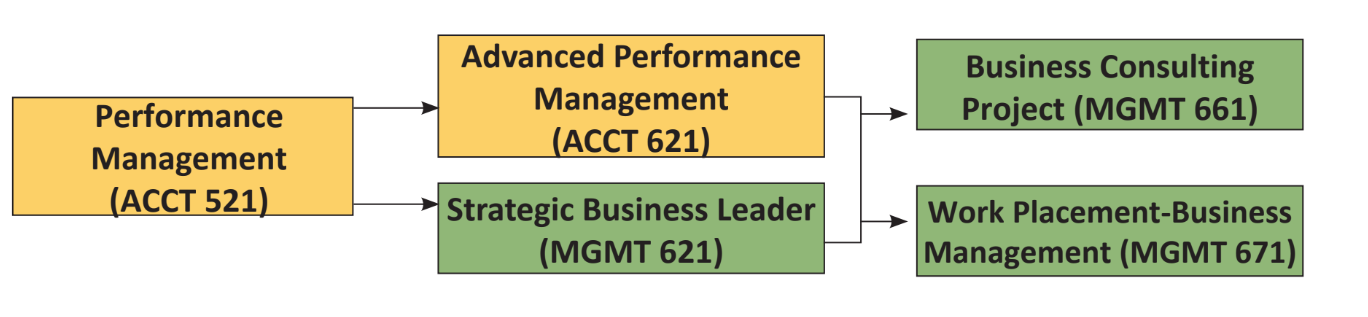
Prerequisites:
There is no prerequisite in addition to the program entry requirements.
The learning outcomes for this course cover six main areas: Information, technologies and systems for
organisational performance, Specialist cost and management accounting techniques, Decision-making
techniques, Budgeting and control, and Performance measurement and control. In addition, it also covers
employability and technology skills. On successful completion of this course, candidates will be able to:
| Knowledge | Level of Learning | Related PLO |
|---|---|---|
| Explain information systems (CK1) Explain the information, systems and development in technology required for organizations to manage and measure performance |
Understand | PK1 |
| Explain cost accounting techniques (CK2) | Understand | PK1 |
| Cognitive Skills | Level of Learning | Related PLO |
| Demonstrate decision-making techniques (CC1) Demonstrate decision-making techniques such as efficient and effective use of scarce business resources and appreciating the risks and uncertainty to facilitate business decisions controlling risks. |
Apply | PC1 |
| Demonstrate budgeting techniques (CC2) Demonstrate appropriate budgeting techniques, methods for planning and control as well as standard costing systems to measure and control business performance and to identify remedial action. |
Apply | PC3 |
| Analyze performance measurement techniques (CC3) Analyze performance measurement techniques from both financial and non-financial perspectives, considering the challenges of controlling divisionalized businesses and the significance of external factors in evaluation. |
Analyze | PC5 |
| Communication, Information Technology, and Numerical Skills | Level of Learning | Related PLO |
| Construct Performance Analysis (CCIT1) Construct Performance Measurement Analysis of a company in Cambodia using financial and non-financial information in a spreadsheet which can be used by the company. |
Create | PCIT1 |
| Interpersonal Skills and Responsibilities | Level of Learning | Related PLO |
| Communicating for research (CIP1) Communicate with executive managers during the research and create a performance measurement and analysis for an existing company in Cambodia. |
Apply | PIP2 |
This course is a hybrid of online and in-person classes, class activities and assignment-based output;
simulations; assigned homework and in-class tests will support learning to material covered in class.
Grades will be determined based on a grading score, calculated using the following assessments and score allocations:
| Topic | CLO Assessment and Scoring | Weighting for Course Grade | ||||
|---|---|---|---|---|---|---|
| Participation | In-class Tests | Controlled Case Studies | Research Assignment | Final Exam | ||
| Explain information systems (CK1) | 50% | 50% | 2% | |||
| Explain cost accounting techniques (CK2) | 10% | 50% Quiz 1 |
20% CCS 1 |
30% | 11% | |
| Demonstrate decision-making techniques (CC1) | 10% | 50% Quiz 1 |
20% CCS 1 |
30% | 20% | |
| Demonstrate budgeting techniques (CC2) | 10% | 50% Quiz 2 |
20% CCS 1 |
30% | 20% | |
| Analyze performance measurement techniques (CC3) | 10% | 50% CCS 2 |
20% | 30% | 20% | |
| Construct Performance Analysis (CCIT1) | 100% | 25% | ||||
| Communicating for research (CIP1) | 100% | 2% | ||||
During the course, there are 4 Simulations and Research assignment:
1- Learning Paper on Simulation that will be completed individually:
Controlled Case Study No. 1 on Decision-making Techniques
Controlled Case Study No. 2 on Performance Measurements
2- A Research on Management Accounting System for a small and medium-sized business
based in Cambodia
Work Arrangement: Group of 2
Output format : APA Format
Report The research proposal will be on a pre-formatted excel spreadsheet.
Language : English
Assignment : The assignment is to prepare a performance analysis report on a company in
Cambodia using their financial and non-financial information using the financial
ratio analysis, Balance Card and the Building Block Model as appropriate. A suitable
explanation of the results of this analysis should be provided.
3- Rubrics will be issued for the Research Paper.
The course targets the 25 lessons in the study plan below. Each lesson is 3 class hours each; there are a total
of 75 class hours. The study plan below describes the learning outcome for each lesson, described in terms
of what the student should be able to do at the end of the lesson. Readings should be done by students as
preparation before the start of each class. Implementation of this study plan may vary somewhat depending
on the progress and needs of students.
| Lesson Learning Outcomes | Teaching and Learning Activities, Assessment |
|
|---|---|---|
| 1 |
Activity-based Costing
(CLO: CK2) |
Technical Presentation and Class discussion. Class Activity using Google Classroom and/or Kahoot! Homework on computation of Absorption costing versus Activity Based Costing using exam-type questions (Constructive Response format) – Google Form via Google Classroom. |
| 3 |
Target Costing
Throughput Accounting
(CLO: CK2) |
Technical Presentation and Class discussion. Homework on computation of Target Cost and Target Cost Gap using exam-type questions (Constructive Response format) – Google Form via Google Classroom Technical Presentation and Class discussion. Homework on computation of Throughput using exam-type questions (Constructive Response format) – Google Form via Google Classroom |
| 4 |
Lifecycle Costing
Environmental Accounting
(CLO: CK2) |
Technical Presentation and Class discussion. Homework on computation of Lifecycle costing and discussing Approaches to Environmental Accounting using exam-type questions (Constructive Response format) – Google Form via Google Classroom |
| 5 |
Cost volume profit analysis (CVP)
(CLO: CC1, CCIT1) |
Technical Presentation and Class discussion. Class Activity – Solving questions via class discussion and results are shown through OneNote Homework on CVP Analysis using exam-type questions (Constructive Response format) – Google Form via Google Classroom |
| 6 |
Limiting factor Analysis
(CLO: CC1, CCIT1) |
Technical Presentation and Class discussion. Class Activity – Solving questions via class discussion and results are shown through OneNote |
| 7 |
Limiting factors Analysis (continuation)
(CLO: CC1, CCIT1) |
Technical Presentation and Class discussion. Homework on Linear Programming using exam-type questions (Constructive Response format) – Google Form via Google Classroom |
| 8 |
Pricing Decisions
(CLO: CC1, CCIT1) |
Technical Presentation and Class discussion. Technical Paper on Pricing for Self-Study |
| 9 |
Pricing Decisions (continuation)
(CLO: CC1, CCIT1) |
Technical Presentation and Class discussion. Homework on Pricing using exam-type questions (Constructive Response format) – Google Form via Google Classroom |
| 10 |
Short-term decisions
(CLO: CC1, CCIT1) |
Technical Presentation and Class discussion. Homework on computation of Absorption costing versus Activity Based Costing using exam-type questions (Constructive Response format) – Google Form via Google Classroom |
| 10 |
Make or Buy Decisions
(CLO: CC1, CCIT1) |
Technical Presentation and Class discussion. Homework on Make or Buy Decision using exam-type questions (Constructive Response format) – Google Form via Google Classroom |
| 11 12 13 |
Dealing with risks and uncertainty in decision-making
(CLO: CC1, CCIT1) |
Technical Presentation and Class discussion. Homework on Pricing using exam-type questions (Constructive Response format) – Google Form via Google Classroom |
| 14 |
Budgetary systems and types of budget
(CLO: CC2, CCIT1) |
Technical Presentation and Class discussion. Homework on Budgeting using exam-type questions (Constructive Response format) – Google Form via Google Classroom |
| 15 |
Budgetary systems and types of budget (Continuation)
(CLO: CC2, CCIT1) |
Technical Presentation and Class discussion. Class Activity using Google Classroom and/or Kahoot! Quiz on Budgeting |
| 16 |
Quantitative Analysis in Budgeting
(CLO: CC2, CCIT1) |
Technical Presentation and Class discussion. Homework on Quantitative Analysis using exam-type questions (Constructive Response format) – Google Form via Google Classroom |
| 17 |
Standard Costing
(CLO: CC2, CC3, CCIT1) |
Technical Presentation and Class discussion. Homework on Variances for simple products using exam-type questions (Constructive Response format) – Google Form via Google Classroom |
| 18 |
Material Mix & Yield Variances
(CLO: CC2, CC3, CCIT1) |
Technical Presentation and Class discussion. Homework on Mix & Yield Variances using exam-type questions (Constructive Response format) – Google Form via Google Classroom |
| 18 |
Sales Mix & Quantity Variances
(CLO: CC2, CC3, CCIT1) |
Technical Presentation and Class discussion. Homework on Sales Mix and Quantity Variances using exam-type questions (Constructive Response format) – Google Form via Google Classroom |
| 19 |
Planning & Operational Variances
(CLO: CC2, CC3, CCIT1) |
Technical Presentation and Class discussion. Homework on Planning & Operational Variances using exam-type questions (Constructive Response format) – Google Form via Google Classroom |
| 20 |
Performance Analysis
(CLO: CC3, CCIT1) |
Technical Presentation and Class discussion. Homework on Performance Analysis using Jamboard or Padlet (short insight on assigned reading). |
| 21 |
Performance Analysis in private sector organisations
(CLO: CC3, CCIT1) |
Technical Presentation and Class discussion. Homework on Performance Measurement using exam-type questions (Constructive Response format) – Google Form via Google Classroom Controlled Case Study no. 2 – Performance Measurements |
| 22 23 |
Divisional performance and transfer pricing
|
Technical Presentation and Class discussion. Homework on Divisional Performance Analysis using exam-type questions (Constructive Response format) – Google Form via Google Classroom |
| 24 |
Performance analysis in not-for-profit organisations and the public sector
(CLO: CC3, CCIT1) |
Technical Presentation and Class discussion. Homework on Performance Analysis of NFP organisations using exam-type questions (Constructive Response format) – Google Form via Google Classroom |
| 25 |
External considerations and impact on performance
(CLO: CC3, CCIT1) |
Technical Presentation and Class discussion. Homework on Performance Analysis using exam-type questions (Constructive Response format) – Google Form via Google Classroom |
| 25 |
Management Information Systems & data analytics
Sources of Information
(CLO: CK1) |
Technical Presentation and Class discussion. Class Activity using Google Classroom and/or Kahoot! Homework using exam-type questions (MCQ format) – Google Form via Google Classroom |
| 27-31 | Intensive Exam Reviews | |
Time for final examinations is not included in the lecture hours above.
Textbook
1. Kaplan Publishing, Workbook/Textbook, Performance Management (latest edition)
2. Kaplan Publishing, Practice & Revision Kit, Performance Management (latest edition)
References
1. BPP Learning Media, Workbook/Textbook, Performance Management (latest edition)
2. BPP Learning Media, Practice & Revision Kit, Performance Management (latest edition)