
1. COURSE DESCRIPTION
On successful completion of this course, candidates should be able to apply excellent leadership and ethical
skills to set the ‘tone from the top’ and promote a positive culture within the organisation, adopting a
whole organisation perspective in managing performance and value creation. In addition, candidates will
be able to evaluate the effectiveness of the governance and agency system of an organisation and recognise
the responsibility of the board or other agents towards their stakeholders, including the organisation’s
social responsibilities and the reporting implications. Candidates will also be able to evaluate the strategic
position of the organisation against the external environment and the availability of internal resources, to
identify feasible strategic options. Furthermore, candidates will gain the approach to analyse the risk profile
of the organisation and of any strategic options identified, within a culture of responsible risk management.
Candidates will also select and apply appropriate information technologies and data analytics, to analyse
factors affecting the organisation’s value chain to identify strategic opportunities and implement strategic
options within a framework of robust IT security controls. Moreover, candidates can also evaluate
management reporting and internal control and audit systems to ensure compliance and the achievement
of organisation’s objectives and the safeguarding of organisational assets. In addition, candidates can also
apply high level financial techniques in the planning, implementation and evaluation of strategic options
and actions.
Candidates should be able to apply innovative thinking, applying best in class strategies and disruptive
technologies in the management of change; initiating, leading and organising projects, while effectively
managing talent and other business resources.
2. REASON FOR THE COURSE
Accelerated digitalization and disruptive business models force companies and organizations to formally set
their strategic direction, (often with assistance of strategy consulting firms such as McKinsey, Bain, BCG),
and to solve a specific strategic or operational issues or external auditing (often with the assistance of
Deloitte, EY, KPMG, PWC) or implement a digital solution (often with assistance of Accenture, IBM, Oracle).
Meanwhile, many multinationals also build their internal consulting and innovation departments to manage
their ongoing strategic change and innovation process.
The aim of the syllabus is to demonstrate organisational leadership and senior consultancy or advisory
capabilities and relevant professional skills, through the context of an integrated case study.
3. STUDY HOURS

4. ROLE IN CURRICULUM
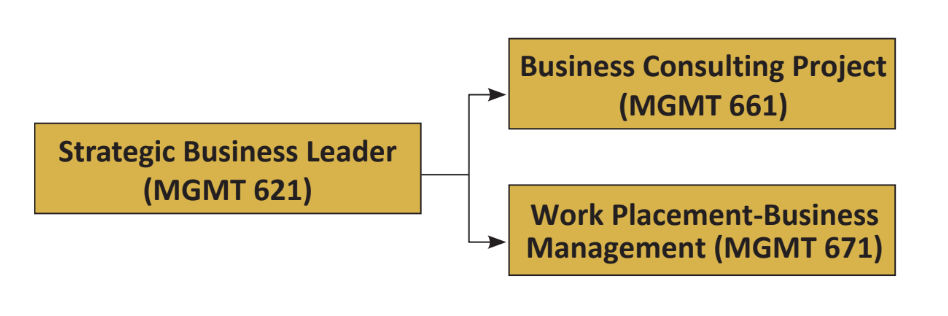
Prerequisites:
There are no prerequisites for this course other than the program entrance requirements. However, students
are encouraged to complete one or more of the following courses before attempting Strategic Leader: STAT
511, ACCT 521, MGMT 525, FINC 612.
On successful completion of this course students should be able to:
| Knowledge | Level of Learning | Related PLO |
|---|---|---|
| Explain the Foundations of Organizational Dynamics (CK1) Explain the concepts of stakeholders, ethics, environmental accountability, agency theory, corporate governance, risks, internal controls, integrated reporting, and strategic management model of strategic assessment, strategic choices and strategic action. |
Understand | PC5 |
| Cognitive Skills | Level of Learning | Related PLO |
| Create an organizational strategy (CC1) Create an organizational strategy to align the mission, vision, goals, objectives, critical success factors and key performance indicators, projects, product portfolio, organisational structure, and IT applications needed. |
Create | PC5 |
| Analyze and conduct Risk Assessment for Informed Decision-Making (CC2) Evaluate the strategic position of the organization against external environment and the availability of internal resources, to identify feasible strategic options and analyse the risk profile of the organization and of any strategic options identified, within a culture of responsible risk management. |
Evaluate | PC5 |
| Evaluate Techniques and Strategies for Dynamic Change Management (CC3) Evaluate high level financial techniques in planning, control and decision making and enable success through innovative thinking, apply best in class strategies and disruption technologies in management of change. |
Evaluate | PC5 |
| Communication, Information Technology, and Numerical Skills | Level of Learning | Related PLO |
| Create a Strategic IT Formulation for Optimal Organizational Outcomes (CCIT1) Formulate IT arrangements to enable successful strategic outcomes. |
Create | PCIT1 |
| Interpersonal Skills and Responsibilities | Level of Learning | Related PLO |
| Critically evaluate the Collaborative Strategic Development (CIP1) Critically evaluate the effectiveness of individual and team-based approaches to developing and presenting feasible strategies. |
Evaluate | PIP1 |
| Formulate the Strategy for Sustainable Success (CIP2) Formulate an ethical business strategy. |
Create | PIP2 |
Grades will be determined based on a grading score, calculated using the following assessments and score allocations:
| Topic | CLO Assessment and Scoring | Skill Weighting for Grade |
|||
|---|---|---|---|---|---|
| Participation and presentation |
In-class mini-case studies (2) |
Strategy Consulting Project |
Final Exam | ||
| Explain the Foundations of Organizational Dynamics (CK1) | 50% | 50% | 100% | ||
| Create an organizational strategy (CC1) | 30% | 50% | 20% | 100% | |
| Analyze and conduct Risk Assessment for Informed Decision-Making (CC2) | 30% | 30% | 40% | 100% | |
| Evaluate Techniques and Strategies for Dynamic Change Management (CC3) | 30% | 30% | 40% | 100% | |
| Create a Strategic IT Formulation for Optimal Organizational Outcomes (CCIT1) | 40% | 30% | 30% | 100% | |
| Critically evaluate the Collaborative Strategic Development (CIP1) | 40% | 30% | 30% | 100% | |
| Formulate the Strategy for Sustainable Success (CIP2) | 30% | 30% | 40% | 100% | |
The teaching methodology will aim at promoting critical thinking among the students and stimulating
student participation during the classes. The students’ knowledge will be periodically reviewed by class
presentations, quizzes, case study analysis, assignment and exam.
EXAM
This course is examined using an integrated case study exam. The case study may use or draw upon some
or all of the main elements of the Integrated Reporting Framework. The examination assesses the technical
and digital capabilities that potential leaders need to demonstrate in senior positions within organisations
but will also be focused on the following professional skills and behaviours: Communication, Commercial
Acumen, Analysis, Scepticism, and Evaluation.
The broad structure of the case study will give candidates information about an organisation from a range
of sources ranging from interviews with stakeholders to internal organizational documents to spreadsheets.
Each case study will require the candidate to take on various roles of organisational leaders, consultants or
advisers to senior management.
Assignment – Strategy Consulting Project
Work Arrangement: Group
Output format : Presentation
Language : English
Assignment : Students will form management consulting teams with 5 members and will explore
strategic issues and innovation in selected industries to develop and recommend
a new strategy. Selected industries may include: Banks, Insurance, Telecom, Audit
& Accounting, Retail & Supermarkets, Airlines, Petrol Stations, Hotels, Café & Food
Chains and Higher Education.
Consulting Projects Assessment Criteria
§ Diagnose strategic issues with a structured problem-solving approach (20%)
• Project team identifies relevant strategic issues and innovation areas
• Project team classifies the root causes of the issues with (MECE) pyramid principle
§ Analyze strategic information with various approaches & methodologies (20%)
• Relevant data with sufficient variety and depth are collected
• Variety of and relevant analyses are performed with an appropriate depth
§ Synthesize findings and translate abstract ideas into actionable insights (20%)
• Compelling insights are generated from the analyses with beyond the obvious results
• Implications for the client organization are revealed: “So What?” is clearly answered
§ Design and evaluate alternative solutions and a roadmap (20%)
• Alternative scenarios are designed & evaluated answering “What should firms do?”
• ext steps and an innovation roadmap are developed
§ Develop and Recommend a new strategy (20%)
• Strategy development process is progressed timely & independently as a team
• New strategy is presented with a clear storyline based on pyramid principle
The course targets the 50 lessons in the study plan below. Each lesson is 1.5 class hours each; there are a total of 75 class hours. The study plan below describes the learning outcome for each lesson, described in terms of what the student should be able to do at the end of the lesson. Readings should be done by students as preparation before the start of each class. Implementation of this study plan may vary somewhat depending on the progress and needs of students.
| Lesson Learning Outcomes | Teaching and Learning Activities, Assessment |
|
|---|---|---|
| 1 | General introduction and Method of Study followed by subject matter: Stakeholders, ethics, environment. Analysing organisation’s stakeholders, ethical decisions and environmental issues, the purpose and rationale of strategy. (CK1, CC2) |
Reading: |
| 2 | Corporate governance (CG) perspectives, agency theory, principles of good CG Assess the CG perspectives, agency relationships, and good CG principles (CC1) |
Reading: |
| 3 | Corporate Governance codes (UK Governance code) Exemplifying a Successful Corporate Governance code Evaluate the underlying tenets of good corporate governance practices (CCIT1) |
|
| 4 | Corporate governance code – continuation |
|
| 5 | Corporate governance for charities, government agencies, and board structure Assess the different corporate governance perspectives of organisations |
|
| 6 | Risks Assess the different types of risks, risk assessment, risk responses, risk correlations, audits and Enterprise risk management |
Reading: |
| 7 | Internal controls and internal audit Assess the internal Control characteristics, signs, limitations, and internal audit remit |
Reading: |
| 8 | Integrated reporting Determine the concept of integrated reporting |
Reading: |
| 9 | Strategy – definition, levels of strategy, how strategies are developed and strategic management model Assess the strategic management model and its elements (CC1) |
Reading: |
| 10 | Strategic position – mission, vision, goals, objectives, critical success factors, key performance indicators Assess the role of targeted objectives in strategy making and implementation (CC1) Apply the concept of setting objectives to real life case studies (CC2) |
Reading: |
| 11 | Strategic position – environmental appraisal – macro-general environment and scenario planning |
Reading: |
| 12 | Strategic position – industry environment – market forces analysis |
Reading: |
| 13 | Porter’s Diamond and introduction of internal appraisal |
Reading: |
| 14 | Strategic position – value chain, value system, processes, product portfolio |
Reading: |
| 15 | Strategic choices – TOWS analysis, Ansoff’s strategies |
Reading: |
| 16 | Strategic choices – external growth – M&A |
Reading: |
| 17 | Strategic choices: Alliances and evaluation |
Reading: |
| 18 | Strategic choices: Capital budgeting |
|
| 19 | Strategic choice: types of changes, contextual features of change success, Force-field analysis |
Reading: |
| 20 | Strategic action: Organisational structure |
Reading: |
| 21 | Strategic action: Culture |
Reading: |
| 22 | Strategic action: Leadership |
Reading: |
| 23 | Strategic action: Project management |
Reading: Textbook 2 (pp. 421-450) |
| 24 | Strategic action: Project management |
|
| 25 | Strategic action: Financial in planning and decision making |
Reading: Textbook 2 (pp. 273-295) |
| 26 | Strategic action: IT – e-commerce, IT security and controls, cloud computing, fintech, blockchain and initial coin offering |
Reading: Textbook 2, (chapter 11, 12) |
| 27 | Strategic action: IT – e-commerce, IT security and controls, cloud computing, fintech, blockchain and initial coin offering |
|
| 28 |
Case Study discussion and Review
|
|
| 29 |
Case Study Review
|
|
| 30 |
Case Study Review
|
|
| 31 |
Case Study Review
|
|
| 32 | Assignment discussion | |
| 33 |
Case Study Review
Assignment discussion |
|
| 34 |
Case Study Review
Assignment discussion |
|
| 35 |
Case Study Review
Assignment discussion |
|
| 36 |
Case Study Review
Assignment discussion |
|
| 37 |
Case Study Review
Assignment discussion |
|
| 38 |
Case Study Review
Assignment discussion |
|
| 39 |
Case Study Review
Assignment discussion |
|
| 40 |
Case Study Review
Assignment discussion |
|
| 41 |
Case Study Review
Assignment discussion |
|
| 42 |
Case Study Review
Assignment discussion |
|
| 43 |
Case Study Review
Assignment discussion |
|
| 44 |
Case Study Review
Assignment discussion |
|
| 45 |
Case Study Review
Assignment discussion |
|
| 46 |
Case Study Review
Assignment discussion |
|
| 47 |
Case Study Review
Assignment discussion |
|
| 48 |
Case Study Review
Assignment discussion |
|
| 49 |
Case Study Review
|
|
| 50 |
Case Study Review
Assignment discussion |
|
| 51 | Assignment Presentation Class (CCIT2) |
|
| 52 | Assignment Presentation Class (CCIT2) |
|
| 53 | Final Exam Review (CCIT1) |
|
Textbook
1. Johnson, G., Whittington, R., Scholes, K., Angwin, D. & Regner, P. (2017), Exploring Strategy – Text
and Cases, 11th ed., Pearson, Pearson Education Limited, UK.
2. ACCA (2021), Strategic Business Leader, BPP Learning Media.
3. Tricker, B (2019), Corporate Governance – principles, policies, and practices, 4th ed., Oxford
University Press, UK.
4. Thompson, Peteraf, Gamble, and Strickland (2019). Crafting & Executing Strategy: The Quest for
Competitive Advantage: Concepts and Readings, 22nd Edition.
5. Lawrence, A.T. & Weber, J. (2017), Business and Society – Stakeholders, ethics, public policy, 15th
ed., McGraw Hill Education, NY.
References
1. Harvard Business Review (2011). HBR’s 10 Must Reads on Strategy.
2. Journal of Business Ethics
3. Corporate Governance: An International Review
4. Managerial Auditing Journal