
1. COURSE DESCRIPTION
To achieve the aims above, this course covers a number of tasks that are divided into two parts. The first
part is the professional orientation which focuses on gaining a clear understanding of the work environment
of the prospective employers and of the job markets in general. After this, the students will be placed at
the selected employers where they will apply their acquired knowledge, skills and attitude in a real work
environment. It is important for the students to comply with the hosting organization’s requirements, to
meet the Performance Objectives (POs) and to keep track of their training progression throughout the work
placement period.
2. REASON FOR THE COURSE
This course aims to develop practical knowledge, skills and attitude of the students and to strengthen their
positions in relevant industries. The students will apply the knowledge and theories acquired in previous
coursework in a real business setting. Through this opportunity the students can explore their interests in
the accounting field and be familiar with the working norms, rules and regulations governing the industry
as well as build a professional business network. The course emphasizes students’ preparation for their
future careers and helps them to be well-trained candidates when they graduate. At the end of the work
placement, the students will be deeply familiar with the key factors for success in an accounting career.
3. STUDY HOURS

4. ROLE IN CURRICULUM
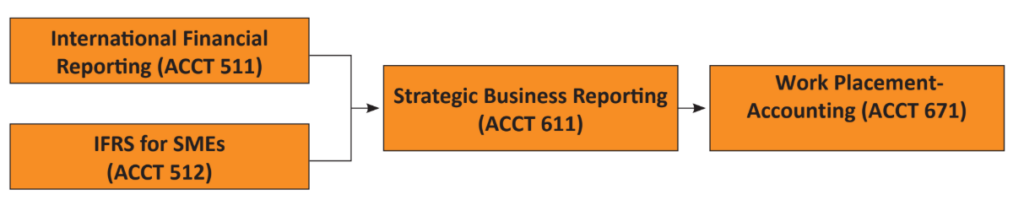
Prerequisites:
To qualify for the work placement, students must have completed the 9-hour preparation activities provided
by Career Services and Student Advising (CSSA) or employer-conducted orientation approved by CSSA.
Students are recommended to complete Strategic Business Reporting (ACCT 611) before taking this course.
On successful completion of this course, students will be able to:
| Knowledge | Level of Learning | Related PLO |
|---|---|---|
| Describe the accounting standards and regulations Describe the requirement of the relevant national and international accounting standards and regulations. |
Understand | PK1 |
| Cognitive Skills | Level of Learning | Related PLO |
| Prepare financial statements Prepare financial statements in accordance with Cambodian International Financial Reporting Standards (CIFRS) and/or CIFRS for SMEs. |
Analyze | PC6 |
| Analyze the information Analyze the appropriate information to measure business performance. |
Create | PC6 |
| Communication, Information Technology, and Numerical Skills | Level of Learning | Related PLO |
| Advise the management Advise the management on how to improve the business performance. |
Analyze | PCIT1 |
| Interpersonal Skills and Responsibilities | Level of Learning | Related PLO |
| Manage a team Manage a team to work productively and ethically in accounting fields. |
Characterize | PIP1 |
Grades will be determined based on the following assessments and score allocations:
| SKILL | Assessment | Skill Weighting for Grade |
|||
|---|---|---|---|---|---|
| Mentor | Peer | Report | Interview | ||
| Describe the accounting standards and regulations | 50% | 50% | 20% | ||
| Prepare financial statements | 50% | 50% | 20% | ||
| Analyze the information | 50% | 50% | 20% | ||
| Advise the management | 50% | 50% | 20% | ||
| Manage a team | 50% | 50% | 20% | ||
This course is primarily an experience-based course. An orientation will be conducted at the beginning
of the course to ensure that the students will gain a clear understanding of the work environment in the
hosting organization and some basic skills for performing their work effectively during the placement. A
variety of methods will be employed to encourage and assess student achievement on course learning
outcomes. Some methods include, but are not limited to, presentation, interview and written reports,
group discussions, business writing, self-reflection, and peer consultation.
Performance Objectives
Students are required to achieve a minimum of four performance objectives in total including all three of interpersonal qualities and the core skills of performance objectives in accounting.
Students may achieve each performance objective by participating in the suggested activities or similar
other activities related to the performance objectives by providing an explanation in the practical experience report.
The performance objectives are set out in interpersonal qualities and core skills as in the appendix 1.
To provide evidence of achieving performance objectives, students are required to request a confirmation
letter from their supervisor with attachment of the performance objectives that they have achieved during the job training.
Personal Experience Report
Work Arrangement : Individual
Output format : Performance Objective Matrix
Language : English
Report : Students will be required to produce a summarized report reflecting the experience
obtained from the job training that satisfies the required performance objectives.
As their training progresses, students should keep track of their experiences. At
the end of the training, students will be required to write a report summarizing the
experience in their own words in a performance objective matrix. The report should
be clear and truthfully reflect the experience with examples provided.
Interview: Students are required to attend the interview by the evaluators and
answer any questions they may be asked during the interview. Rubric
| Lesson Learning Outcomes | Teaching and Learning Activities, Assessment | |
|---|---|---|
| 1 |
Course Orientation
|
|
| 2-18 | On-the-job training (All CLOs) | Apply knowledge and skills |
References
1. ACCA rule book https://www.accaglobal.com/gb/en/about-us/regulation/ethics/acca-rulebook.html
ACCA performance objectives
1. https://www.accaglobal.com/vn/en/student/practical-experience-per/performance-objectives.html
These are the important elements of interpersonal qualities that students must achieve. They are required to maintain the professional code of ethics, develop productive business relationships with stakeholders and take initiative as a leader during work.
| Performance Objectives | Suggested Activities |
|---|---|
| Maintain professional code of ethics |
|
| Develop productive business relationships |
|
| Apply leadership and self development |
|
This involves students in the process of recording and processing transactions and events using appropriate accounting systems, reviewing and preparing financial statements in accordance with accounting standards and legislation. In addition, students are also able to take part in management accounting such as planning the business activities, controlling the performance, preparing and monitoring the budget, and making recommendations for improvement.
| Performance objectives | Elements |
|---|---|
| Record and process transactions and events |
|
| Prepare external financial report |
|
| Plan and control performance |
|
| Monitor and report performance |
|